*Updated 2026-05-18 to include trade-built AI receptionist coverage (NeverMiss).*
Last May, an HVAC service tech with the username FriendlyUse356 posted this on r/HVAC: "I've been leaning heavily on ChatGPT to get through pretty much every service call. Five-year gap left me rusty, and tech keeps evolving. Instead of pretending I've got every wiring diagram memorized, I pull up my trusty AI assistant and get a quick crash course on the fly. I'm making $35/hr and honestly feeling like a cyberpunk fraud, except the systems are getting fixed, customers are happy, and no one's dead (yet). So is this cheating? Or is this just modern problem-solving?"
1,160 upvotes. 410 comments. The top reply: "I'm 47 and I've been faking it my whole life. Let me know when you got it figured out."
The point isn't whether techs should use ChatGPT. The point is they already are, and they have been for over a year. The conversation about AI in HVAC has moved past "should we?" to "which AI tools actually move money for the shop, and which are marketing fluff?"
AI can't put a wrench on a contactor. It can't pull refrigerant or pass an EPA 608 inspection. But it can stop you from leaking the calls that pay for the wrench. That's the framing this post runs on. We're going to walk through the four AI tools that actually move money for a 5-to-50-truck HVAC shop, the three that get sold hard but rarely earn back the subscription, and where to start if you've never turned anything on.
You don't need to like AI to use it. You just need to know which slice of your day it'll quietly fix while you're on a roof.
The four bottlenecks AI actually fixes for HVAC owners
Most AI HVAC content lists 27 use cases and ranks them alphabetically. That's how you get an article nobody finishes reading. Here are the four worth your money, ordered by dollar leak.
1. Missed calls during peak
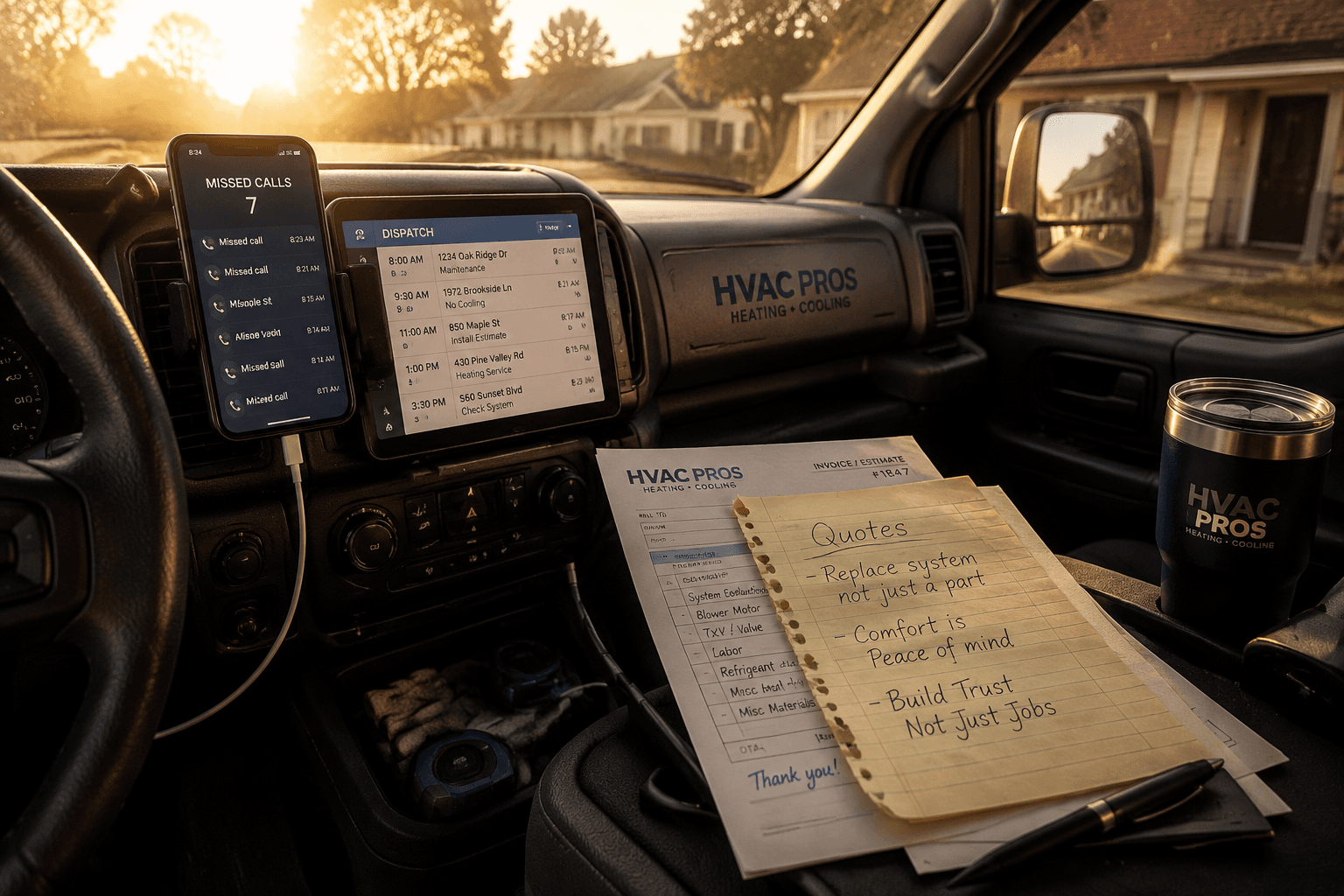
The biggest dollar leak in residential HVAC isn't your CAC, your tech turnover, or your truck stock. It's the inbound calls that ring out during a heat dome week. Industry data: 27% of inbound calls go unanswered, and 78% of buyers go with the first company that answers (Invoca). SkipCalls peak-season data adds another nail. In summer, most unanswered HVAC callers hang up and dial the next shop on Google before the voicemail beep.
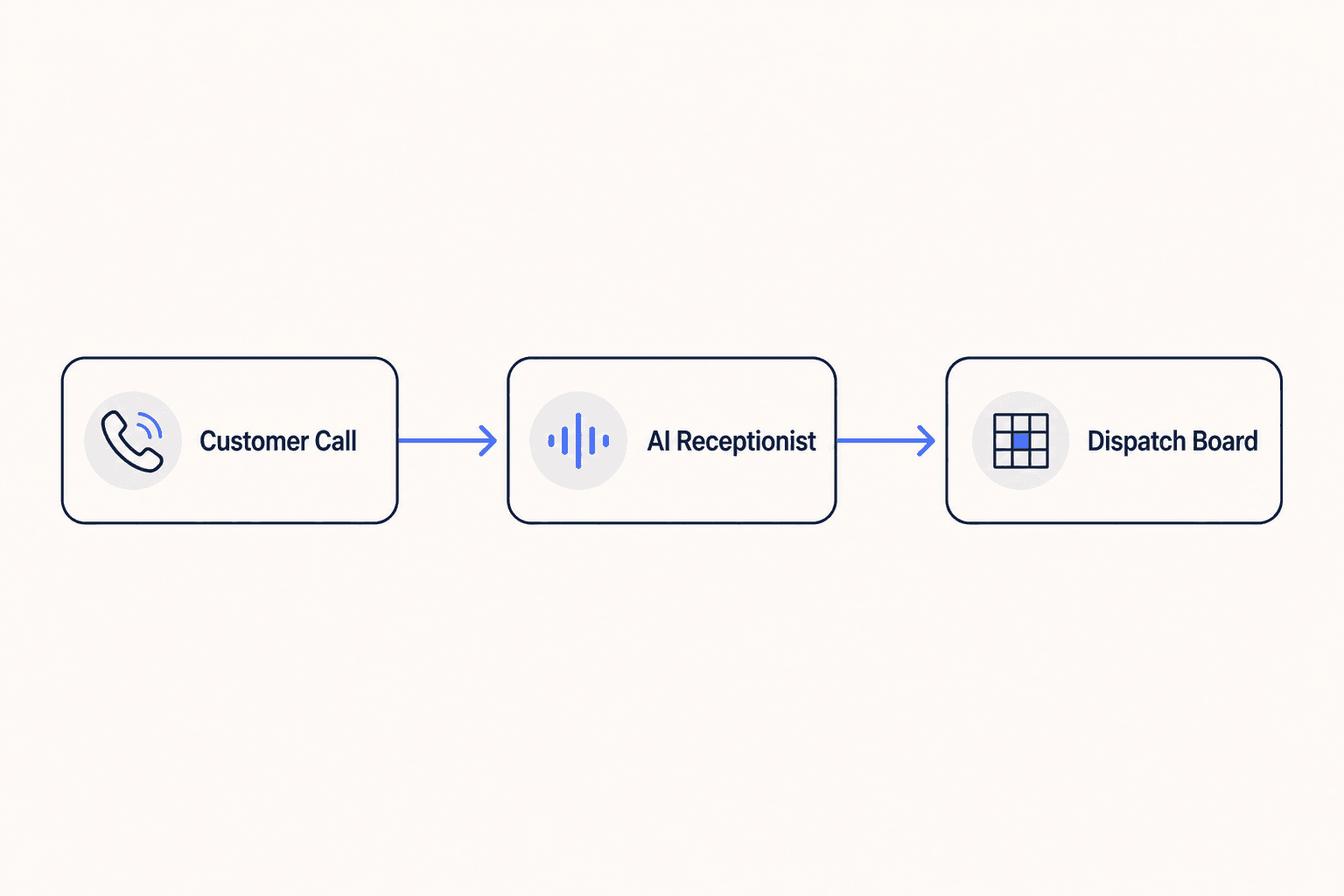
An AI receptionist that answers in two rings, qualifies the call, and books the work into your dispatch board recovers calls a human dispatcher loses. We built one for our compliance and inspection client Noble Fire & Safety, and they've gone zero missed inspections since the switch. The HVAC application is the same shape with different field names.
Tools that actually do this well: NeverMiss, a trade-built AI receptionist (HVAC, plumbing, roofing, electrical), Avoca, ElevenLabs-tier voice agents, and custom builds tuned to your equipment matrix. Tools that don't: anything that costs $25/month and says "AI receptionist" in the headline.
2. The 30-minute quote that costs you the job
The 1-to-3 day quote lag is the second biggest revenue leak in residential HVAC sales. Customers call three shops. The first one back wins more than half the time. If your tech does a no-cool diagnostic, drives back to the shop, opens a spreadsheet, and sends a quote at 9 PM, you've already lost two of the three.
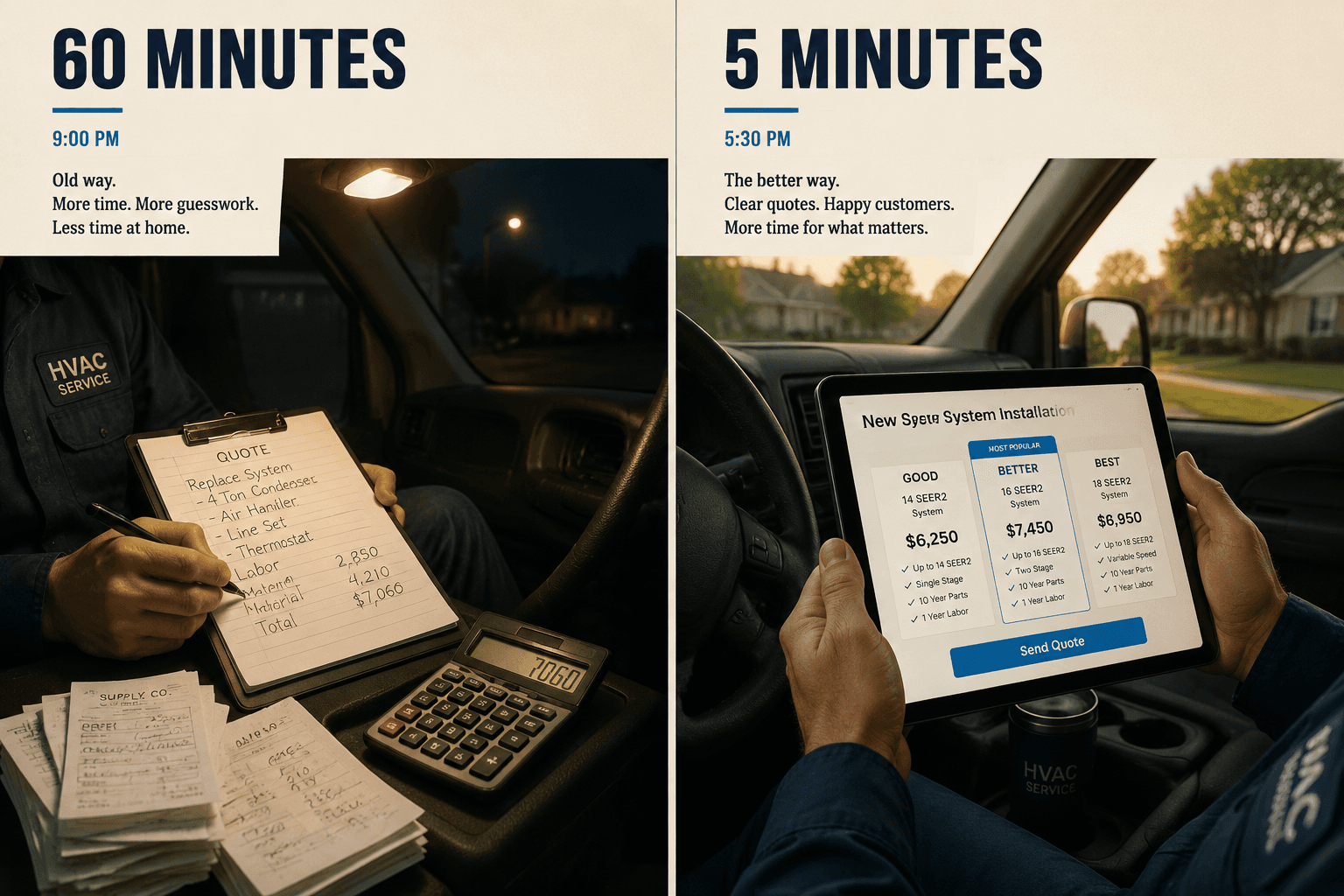
Our roofing edge metal client Meridian Shield used to spend an hour on every quote. We built them an automatic sheet calculation system with two-bucket pricing (sheet cost with markup and tax, production cost without). Their quotes now take under five minutes. Their close rate went up because they were the first quote in the customer's hand. Same shape works for HVAC: tonnage in, equipment matrix selected, good-better-best generated, signed before the tech walks back to the truck.
"We went from spending an hour on every quote to under five minutes. The system paid for itself in the first month." — Meridian Shield
3. Estimate follow-up that nobody does
The third leak is quotes you've already given that are sitting cold. The industry-standard cadence is touch on day 3, day 7, day 14. Most shops do day 1 then forget. The estimate follow-up assistant we built for Vaught AI Labs (Cure Rituals, our sister brand) reads your inbox at 5:30 AM, summarizes which quotes need a touch today, drafts the message, and waits for you to hit send. It also reads yesterday's job board and flags anything that closed without an invoice going out.
Sister-brand framing matters here. Cure Rituals is our own company. We built this for ourselves first. We use it before we sell it.
4. After-hours noise
41% of home-service jobs book after hours (Avoca). If you're not staffed at 7 PM, you're either paying a $1,200/month answering service that books five calls a month, or you're letting it go to voicemail and hoping the customer waits until morning. They don't.
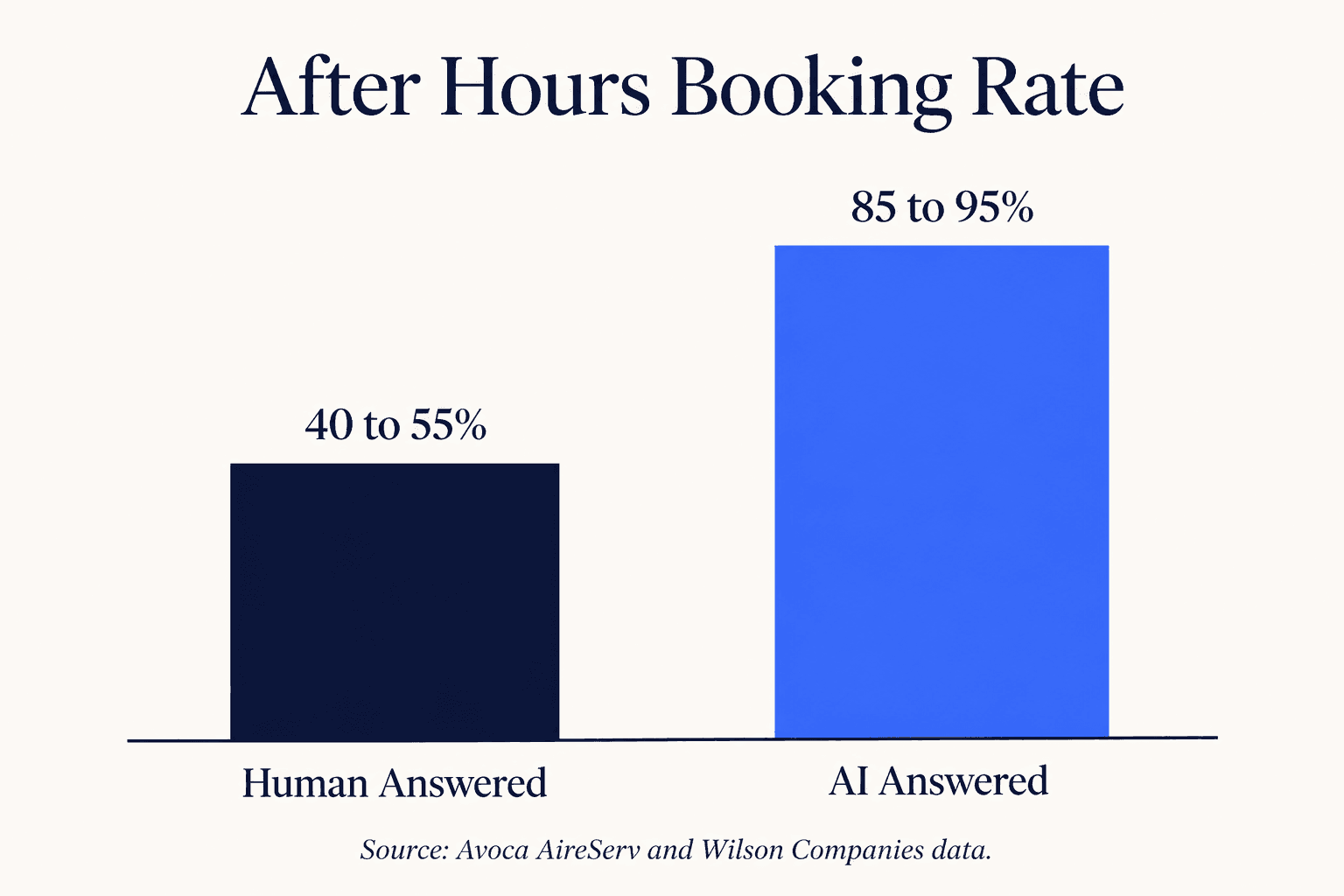
This is where the AI receptionist earns its keep a second time. Same tool as bottleneck 1, working a different shift. Booking-rate data we trust: human-answered after-hours hovers at 40-55%, AI-answered hits 85-95% (Avoca's AireServ and Wilson Companies case studies).
Will AI replace HVAC techs, dispatchers, or CSRs?
No. The most-upvoted r/HVAC post from 2025 said it cleaner than I will: "AI can't install an HVAC system" (4,187 upvotes on r/technology). The trades are insulated from displacement because the work is physical, the diagnostics are sensory, and the customer is in the room.
I pulled wire underground at NAVFAC. Helicopter pad approach lights, taxiway edge, SEAL training pool electrical. AI can't do any of that. It also can't take the 6 AM voicemail triage off your dispatcher's plate, draft the day-7 follow-up on a stale quote, or answer the no-cool call at 8:45 PM on a Sunday. Different jobs, both real.
What AI does replace is the part-time after-hours answering service you're paying $1,200 a month, the dispatcher's first hour every morning, and the 1-to-3 day quote follow-up cadence nobody actually runs. Reframe: AI doesn't fire your CSR. It gives her a Tuesday morning that doesn't start at 6:45 with three voicemails to chase.
The hidden math on missed calls
Most HVAC owners feel the missed-call pain. Few have done the math. Here's the floor.
Average HVAC service ticket: $1,205 (Housecall Pro 2025). Calls missed per day during peak season: 3-5 for a 10-truck residential shop. Booking rate when calls do get answered fast: 50-70%. Industry rule of thumb: missed-call cost = (missed calls per day x ticket value x booking rate x work days).
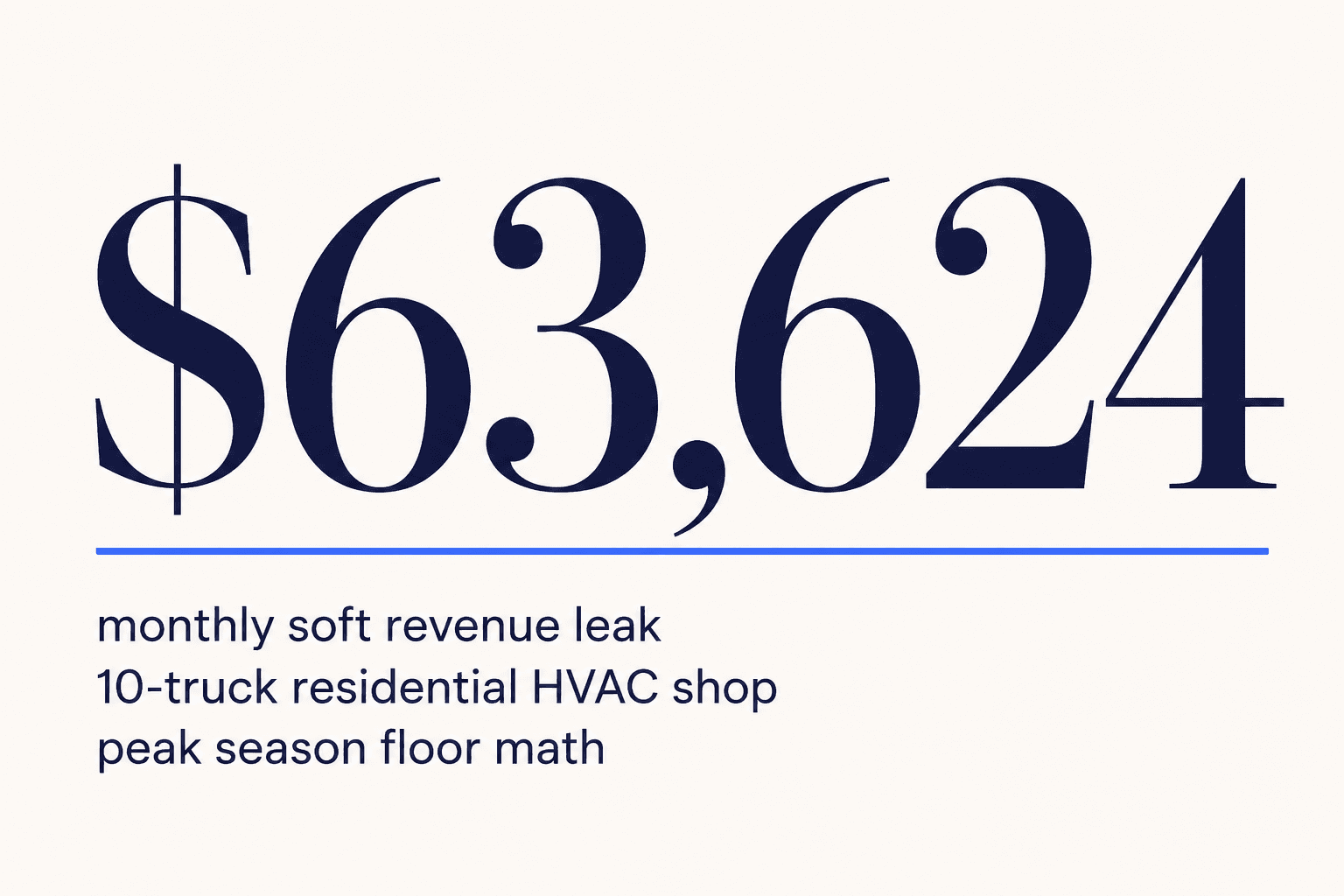
Run the math. 4 missed calls x $1,205 x 60% booking x 22 work days = $63,624 a month in soft revenue leak. That's not a typo. That's the floor for a 10-truck residential shop during a peak month.
You will not recover all of it. A realistic AI receptionist captures 60-80% of after-hours and overflow. Even at the low end, you're looking at $30K-$45K/month recovered for a tool that costs a fraction of one tech's loaded hourly rate.
What about Housecall Pro, Jobber, ServiceTitan, and the rest?
Honest answer: if you have one, keep it. They run the dispatch board, the customer database, and the sync to QuickBooks. We don't replace any of that.
What they don't do well, in our experience and in the brutal Reddit threads we read: they don't catch the calls that ring out, they don't draft the quote in five minutes (you still type), they don't follow up on cold estimates without a human pushing the button, and they don't read your day to you at 5:30 AM. They are great at the parts they were built for. They were not built for the parts AI now solves.
ServiceTitan's Atlas, Housecall Pro's CSR AI, and Jobber Receptionist are real products. They're also expensive add-ons that mostly cover one piece of the four bottlenecks above (intake). For shops under $5M, the cheaper move is a custom layer that fits your dispatch board, your equipment matrix, and your shop's voice. For shops over $10M, the FSM-native AI starts to make sense once integration cost stops outweighing platform cost.
Most AI consultants will tell you to start with ServiceTitan Atlas or Housecall Pro CSR AI because it's the safe answer. That's wrong if you're under 10 trucks. The integration math doesn't work yet at that size, and you end up paying for a feature set built for a 50-truck commercial operation. The cheaper move is a custom layer that fits your shop today, then graduate to FSM-native AI when you cross the $5M-$10M revenue line and the integration cost stops outweighing platform cost.
How to start: the order operations actually fix things
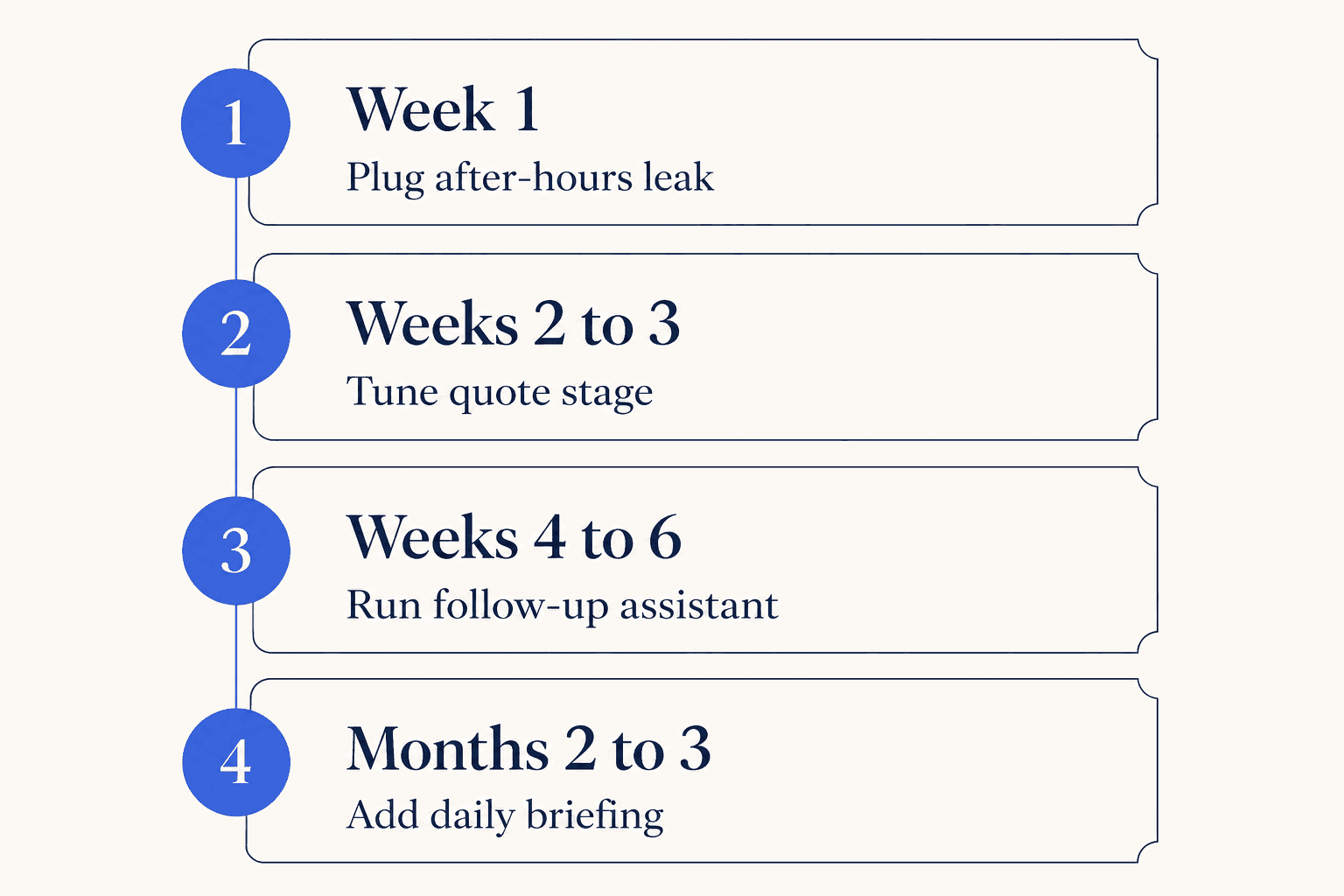
Don't try to turn on four tools in the same month. The order that works:
Week 1: Plug the after-hours leak. AI receptionist answers everything inbound after 5 PM and on weekends. Two-week trial, watch the booking rate.
Week 2-3: Tune the quote stage. Equipment matrix in, good-better-best out, sent from the truck before the tech leaves.
Week 4-6: Run the follow-up assistant. Drafts the day-3, day-7, day-14 touches on cold estimates. You hit send. Closes the back-half leak.
Month 2-3: Add daily briefing. 5:30 AM rundown of what closed yesterday, what's stale, what needs your eyes today. The morning is the cheapest hour you have.
We package this as the Recovery Blueprint. Foundation Outcome Guarantee: your first AI automation is live in 30 days, or we don't bill the retainer.
Frequently asked questions
What is the $5,000 rule for HVAC?+
The $5,000 rule is the homeowner-facing rule of thumb shops use to frame the repair-versus-replace conversation. Multiply the system age in years by the estimated repair cost. If the result is over $5,000, recommend replacement. If it's under, recommend repair. It's not law. It's a sales framing tool that lands because the math is simple and the customer feels in control.
Will AI replace my dispatcher, CSR, or techs?+
No. AI replaces the after-hours answering service you're paying $1,200/month, the cold estimate follow-up your dispatcher never has time to run, and the 5:30 AM voicemail triage. It doesn't replace the human picking up at 9 AM and routing live. It gives that human a quieter Monday morning.
Is HVAC AI just ChatGPT with a wrapper?+
Some of it is. Some isn't. The wrapper IS the product, because the wrapper is what knows your service plan rules, your equipment matrix, your tech roster, and your call-routing logic. Generic ChatGPT can't book a job into your dispatch board. The custom layer that does is the part you're paying for.
Can an AI receptionist book jobs into ServiceTitan, Housecall Pro, or Jobber?+
Yes, on the better tools. Native integrations exist for ServiceTitan (Atlas), Housecall Pro (CSR AI), and Jobber (Jobber Receptionist). Third-party AI receptionists like NeverMiss, Avoca, Smith.ai, and Goodcall offer integrations with most major FSMs. When you have both your FSM AND a third-party AI receptionist, sync direction matters. Pick one as the source of truth for customer records before you turn anything on. Pricing models split into two camps: flat-rate per location (NeverMiss starts at $500/month) and per-minute (Smith.ai, RingCentral AIR). Flat-rate wins when call volume spikes during peak weather; per-minute wins when volume is low and predictable.
How does AI handle Spanish-speaking customers?+
Multi-language handling is now table stakes on the better voice agents. RingCentral AIR supports 7 languages. Nextiva Xbert covers English, Spanish, French, and Portuguese. Smith.ai and Avoca handle automatic Spanish detection. For OK, TX, AZ, and CA shops with 13-15% Spanish-primary households, this should be a hard yes-or-no requirement before signing a contract.
What happens when AI books a job we can't run?+
Only if you let it. The first thing we wire up is the calendar gates. Install jobs require a 2-tech crew available. Refrigerant work requires an EPA 608 tech. After-hours emergencies route to the on-call tech only. Anything outside the rules books as a "needs review" slot, not a confirmed job. Override authority sits with your dispatcher, not the AI.
How much are missed calls actually costing my HVAC business?+
Floor math for a 10-truck residential shop during peak: 4 missed calls/day x $1,205 average ticket x 60% booking rate x 22 work days = $63,624 in monthly soft revenue leak. Realistic AI receptionist recovery: 60-80% of after-hours and overflow. Even at the low end, $30K-$45K/month for a tool that costs less than half a tech's loaded hourly rate.
What's the first AI tool to turn on Monday morning?+
Whichever one closes the biggest dollar leak first. For most $1M-$5M HVAC shops, that's the after-hours AI receptionist. 41% of home-service jobs book after hours, and the missed calls are the loudest dollar leak. For shops with the phone covered, mobile quoting is next. The 1-3 day quote lag is the next-biggest leak, and the customer who gets the first quote wins more than half the time.
See the playbook in action
Four feature-specific case studies. Each is one named feature, one named operator, real numbers.
Missed-call recovery, Noble Fire & Safety: zero missed inspections since the switch. 5+ hours saved per week on admin. Mobile-first PWA that works offline in a basement utility room.
5-minute invoicing, Meridian Shield: quote time dropped from 60 minutes to under 5. 3x quotes per day. The system paid for itself in the first month.
Morning briefing assistant, Vaught AI Labs (Cure Rituals): 5:30 AM rundown of yesterday's job board, today's stale quotes, and what needs your eyes. We built this for our sister brand first. We use it before we sell it.
Sovereign Brain, Vaught AI Labs (Cure Rituals): private AI that runs on your own infrastructure. No data leaves your shop. For owners who can't put customer records in the cloud.
See the full HVAC vertical playbook for the on-site quiz, ROI calculator, and Recovery Blueprint download.
Joey Vaught, Founder, Vaught AI.
30 min. We map the four bottlenecks against your shop, name the dollar floor on each leak, and show you which tool fixes the biggest leak first. Foundation Outcome Guarantee: your first automation is live in 30 days, or we don't bill the retainer.