
Starting June 15, 2026, Anthropic moves the Claude Agent SDK to a separate metered credit pool, separating programmatic Claude usage from human-driven subscription usage. Pro plans get $20 in monthly Agent SDK credit, Max 5x gets $100, Max 20x gets $200, all billed at standard API rates with no rollover.
If you run a small business and the only thing you use Claude for is the chat window, this changes nothing for you. If you have a developer, an agency, or an internal automation that pipes Claude into a GitHub Action, a cron job, a scheduled scraper, or a third-party app like Zed or Cursor, your June bill is about to look different.
This is the first honest pricing event of the agent era. Subscription buffets do not survive software that can burn tokens 100 times faster than a human types. Anthropic was first. OpenAI and Google will follow within two quarters.
Here is what is actually changing on June 15, what to do about it before the cutover, and what it means if you have an AI partner who has been selling you 'unlimited Claude' as part of a flat retainer.
Here is what every SMB running Claude needs to know in 30 seconds.
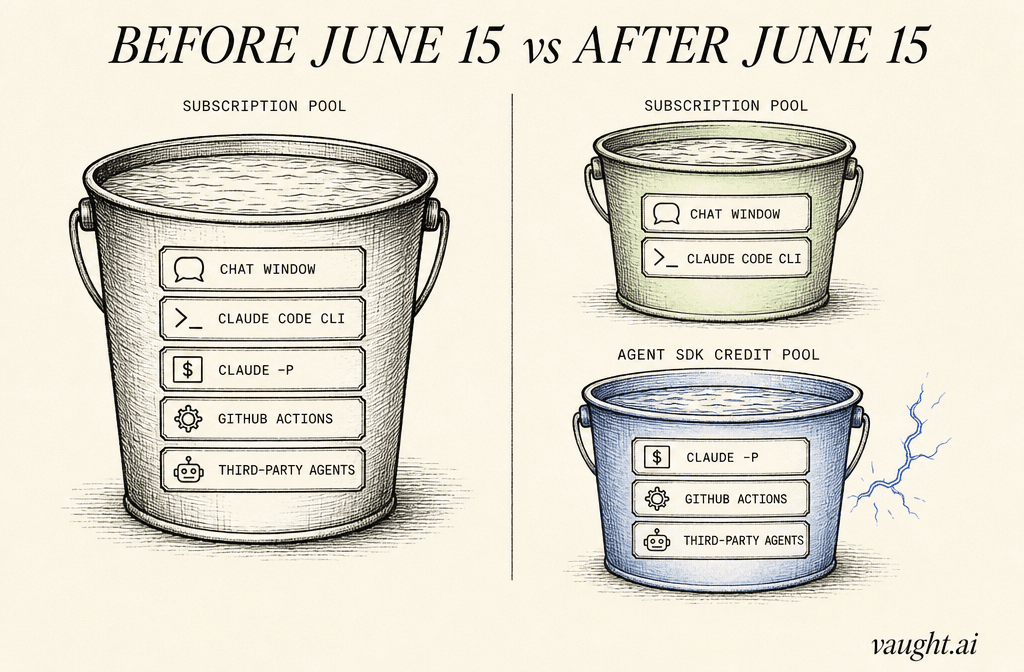
Effective 2026-06-15. The Claude Agent SDK, the `claude -p` CLI command, Claude Code GitHub Actions, and every third-party app that authenticates through your Claude subscription move off your existing usage pool and onto a new metered Agent SDK Credit pool.
Credit amounts. $20 monthly for Pro, $100 for Max 5x, $200 for Max 20x. Billed at standard API rates. Resets on your billing date. Does not roll over.
Unaffected. The interactive chat at claude.ai and the interactive Claude Code CLI you type into stay in your existing subscription pool. No change there.
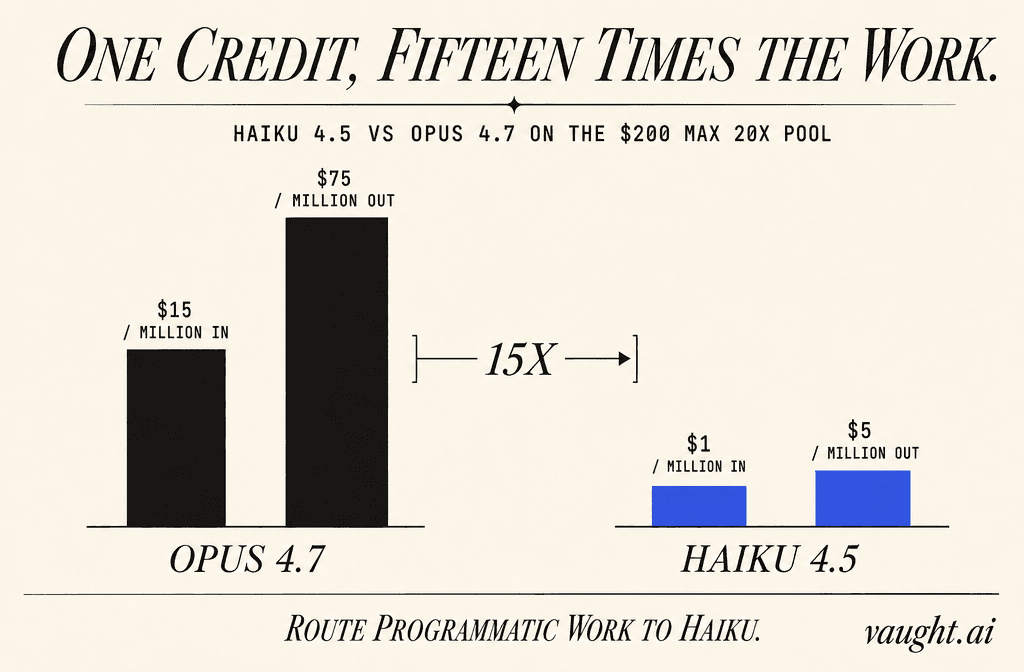
What to do before June 15. Enable API overage billing on console.anthropic.com so scheduled work does not silently fail. Audit which of your Claude integrations are programmatic versus interactive. Route programmatic loads to Haiku 4.5 (15x cheaper than Opus 4.7) wherever a smaller model is sufficient.
What Anthropic is actually doing on June 15
The change is a billing split. Right now, every Claude Pro, Max, Team, or Enterprise subscription has a single usage pool. Whether you use Claude in the chat window, through the Claude Code CLI, in a `claude -p` headless call, or through a third-party agent app, it all draws from the same monthly quota. On June 15, Anthropic separates the second category into its own bucket.
The new bucket has a name. Agent SDK Credit pool. Pro gets 20 dollars in monthly credit. Max 5x gets 100 dollars. Max 20x gets 200 dollars. The credit refreshes on your billing date. It does not roll over. Once it is gone, programmatic Claude calls return an error unless you have explicitly enabled API overage billing.
The interactive Claude Code CLI you type into stays in the subscription pool. That is not affected. Neither is the chat window at claude.ai. The change is specifically about programmatic, headless, or third-party usage. Anthropic's own support page on the change is the primary source for the credit-pool mechanics. The four surfaces that fall into the new pool are the Claude Agent SDK itself, the `claude -p` non-interactive CLI command, Claude Code GitHub Actions, and every third-party application that authenticates through your subscription (OpenClaw, Conductor, Zed, Jean, Cursor when used in agent mode).
Anthropic's stated reason is honest. Programmatic usage costs them real compute, and a 20-dollar Pro subscription was being turned into hundreds of dollars of API-equivalent work through agent wrappers. The carve-out preserves what a human subscriber thinks they are paying for, and prices what an agent actually costs.
Within hours of the announcement, a Rust wrapper called claude-pee showed up on Hacker News that bypasses the new pool by running Claude Code inside a pseudo-terminal, pretending to be an interactive user. Anthropic has not commented. That cat-and-mouse will keep going. InfoWorld's coverage is the cleanest third-party walkthrough if you want a deeper read. The underlying signal will not change.
Why "unlimited AI" was always a lie
Software has always been priced on the assumption that a human is on the other end. A subscription buys you a seat. A seat is one person, who clicks buttons at human speed.
An agent is not a seat. An agent is a process that can run for hours, call the model thousands of times, and burn through what would have been a month of human-driven usage in 90 seconds. When the user is software, the seat model breaks.
Every AI vendor has known this for a year. Most of them kept selling 'unlimited' anyway because the alternative was getting beaten on a pricing page. The bet was that most people would not write agents, so the cost of the rare power user would average out.
Then ChatGPT shipped agents. Claude shipped agents. n8n shipped agent nodes. Cursor and Zed and Windsurf and Cline started letting users plug a Claude subscription into a wrapper and run a daemon. The bet broke. This is the same Anthropic-as-platform pattern we wrote about three weeks ago in the Claude for Creative Work breakdown. Model layer commoditizes, integration layer becomes the product.
What you are watching on June 15 is the first frontier lab admit it out loud. Programmatic usage will be metered, not buffeted. OpenAI ships the same change inside two quarters. Google will follow. The agent economy gets priced like AWS, not like Netflix.
If you have been thinking of AI subscriptions as a flat monthly cost, you have been pricing on the consumer model. Once you have an agent in the loop, you are buying inference like a cloud service. That requires a different mental model and, increasingly, a different kind of partner.
Three things every operator running Claude should do before June 15
You have 30 days. If you run any Claude automation as part of your operation (and at this point most SMBs are running some flavor of AI automation, whether or not anyone has called it that), here is the short list.
First, enable API overage billing on your Anthropic account today. Log into console.anthropic.com, go to billing, and turn on the option that lets the SDK keep working after the monthly credit is exhausted. The alternative is your scheduled GitHub Action or cron job silently failing at 2 AM on June 28 because you ran out of credit and there was nothing to fall back to. Pay the dollars or stop the automation. Do not let the automation stop you without a warning.
Second, audit your stack. Walk through every Claude integration you have and tag it interactive or programmatic. Interactive means a human types into the terminal and gets an answer. Programmatic means a scheduled job, a webhook, a CI step, or an automated workflow calls Claude without a human in the loop. Only the second category drains the new credit pool. We did this for our own brain last week. We have around 30 Claude Code skills and 11 internal agents. Most are interactive (someone types into the terminal and the skill runs). About a quarter are programmatic (a recurring loop, a scheduled morning briefing, a Mission Control endpoint that fires nightly). Once you know which is which, you know exactly which workflows have a new cost line on June 15.
Third, route programmatic loads to Haiku, not Opus. Haiku 4.5 is 1 dollar per million input tokens and 5 dollars per million output tokens. Opus 4.7 is 15 dollars per million input and 75 dollars per million output. For most scheduled work (summarizing a document, classifying an email, drafting a first pass), Haiku is fine. The 200-dollar Max 20x credit goes 15 times further on Haiku. Reserve Opus for the interactive complex work where you actually need the smarter model. This is the single most useful change you can make before the cutover.
If you do those three things by June 14, the cutover is a non-event for your business. If you do none of them, you find out about the new model by getting a billing alert or a failed cron at 3 AM.
What it means if you have an AI partner on retainer
This is where the change gets sharper for anyone selling or buying AI services.
For the last two years, most AI consultancies have been priced like a SaaS reseller. Flat monthly retainer, 'unlimited Claude usage included,' set-and-forget. The retainer assumed the underlying subscription was a flat cost. That assumption stops being true on June 15 for any retainer that includes scheduled automations, GitHub Actions, or third-party agents. It is the same problem we covered when we wrote about build versus buy decisions for small business software. The question is whether your AI partner is reselling you somebody else's product or actually architecting your stack.
There are two kinds of AI partners now. The first is the SaaS reseller, still pricing flat, still hoping the customer does not notice when scheduled jobs start failing or when the partner quietly stops running the heavier automations to keep the credit pool alive. That partner is about to get squeezed. Zed posted a short note on what the change means for their Claude integration the day Anthropic announced it. The pricing model their engineering team articulates is the right mental model for any SMB partner you might be working with.
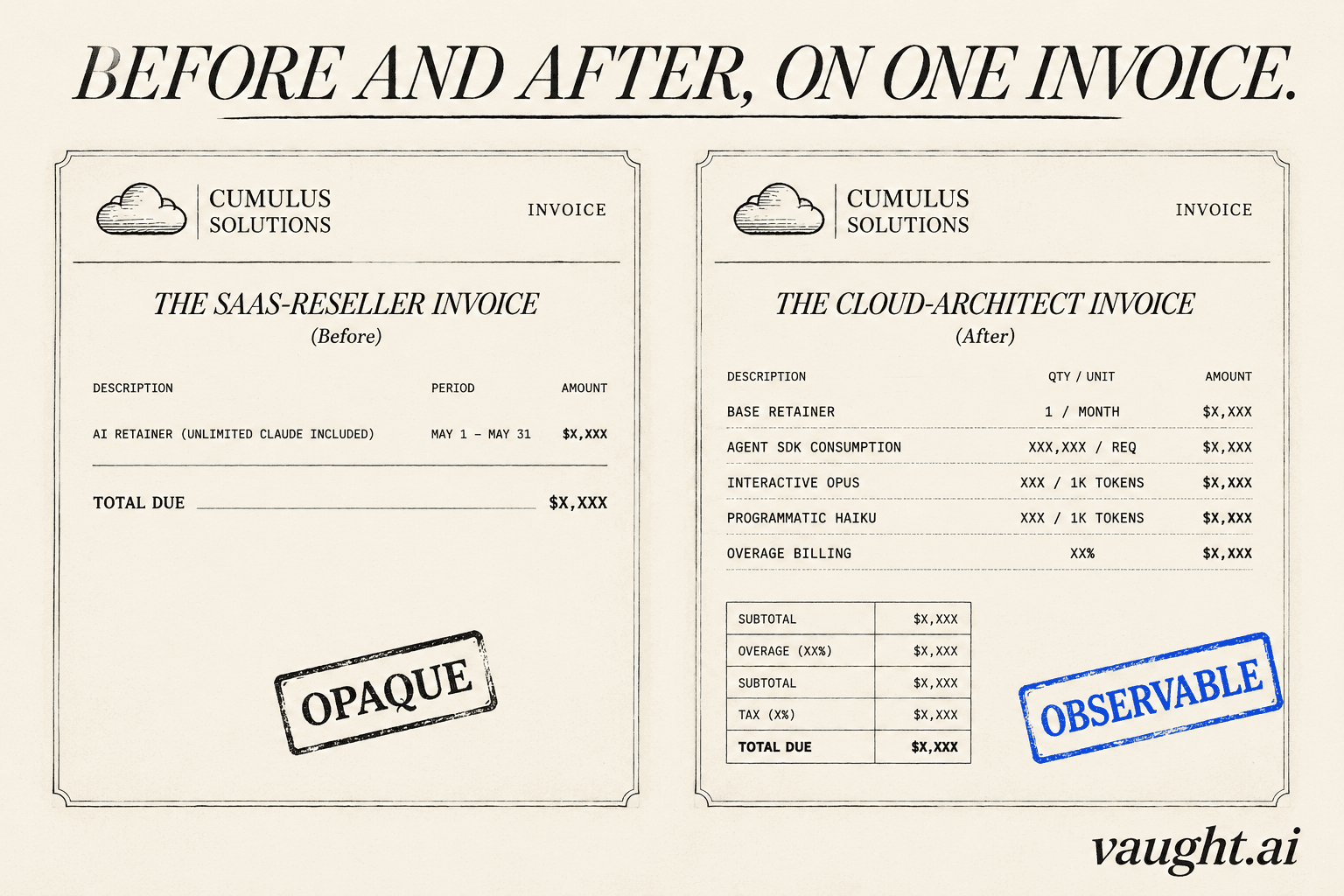
The second is the partner who thinks like a cloud architect. Consumption-aware. Routes programmatic loads to Haiku and keeps Opus for interactive complex work. Builds observability into every automation so you can see which workflow burned what. Tells you, in plain English, what the new June bill will look like and why. That partner gets paid more because the work is more, and because the operator can see the bill in detail and reason about it the same way they reason about a power bill or a payroll bill.
Vaught AI has been priced like the second kind from day one. Our Foundation tier is a base retainer plus inference cost passed through at our cost, with a full audit trail of which automation burned what. Every monthly invoice shows the consumption side broken out. When the June 15 change lands, our clients see one new line item in the invoice and a one-paragraph explanation of why. Nobody gets surprised.
If you have a partner selling you 'unlimited everything' for a flat fee that includes scheduled work, ask them what changes on June 15. If they say 'nothing,' they either do not know about the change yet, or they are about to start quietly throttling your work. Same outcome for you, different reason.
How we are handling it on June 15 in our own stack
I run the Vaught AI internal brain (the workflow engine, the agents, the morning briefing, the news digest, the publishing pipeline) on a stack of around 30 skills sitting on top of Claude. Some of those skills are interactive (I type into the terminal and they fire). Some are scheduled (a Sunday content batch, a Friday review, a daily news sweep). Most have not been split that way explicitly because the subscription pool covered everything.
Two weeks ago, when the change leaked, our infrastructure agent (we call him Otto) started auditing the stack. By June 14, every programmatic surface will be tagged, every Haiku-eligible workload will be routed to Haiku, every scheduled job will have API overage billing enabled, and our monthly invoice template will gain a new 'Agent SDK consumption' line so any client running scheduled work through us sees exactly what the new cost is.
That is one engineer-week of work for an in-house team already familiar with the infrastructure. For most operators running a 5-to-50-person business with one IT person and a couple of AI integrations from a vendor, it is a four-conversation project. Pull a list of every Claude integration you have. Decide which are programmatic. Switch the cheap ones to Haiku. Enable overage billing.
If your AI partner cannot give you a one-paragraph plan for those four conversations by next week, you have your answer about which kind of partner they are.
What this signals for the rest of 2026
June 15 is the first event. Two more will follow inside two quarters.
OpenAI will ship a structurally similar split. They are already feeling the same pressure. CFO Sarah Friar said on May 15 that the company needs to raise more capital to keep up with compute demand, the same week they shipped ChatGPT Personal Finance with Plaid and added another consumer surface that will drive agent calls. When they ship their version of the split, the marketing language will be different (something about 'API parity' or 'agent credits') but the underlying math will match Anthropic's.
Google will ship the same thing for Gemini, probably wrapped inside Workspace pricing. Gemini Intelligence is rolling out to Android phones this summer, and the consumer expectation will be unlimited until enough developers wire up agents and the cost line gets ugly.
The bigger story is that the industry just learned the lesson. AI subscriptions for humans get to stay flat. AI for agents gets metered. Every vendor will eventually run the same play, because the alternative is losing money on every power user.
For an SMB owner, the actionable takeaway is simple. The cheapest AI cost line in your business right now is going to get more expensive, and you should know which automations are draining what before the bill teaches you. Get that visibility now, before the rest of the industry follows Anthropic in.
Does this affect my Claude Pro or Max subscription if I only use the chat window?+
No. The interactive chat window at claude.ai and the interactive Claude Code CLI both stay in the existing subscription pool. The change only affects programmatic, headless, and third-party usage that authenticates through your subscription credentials.
What counts as "programmatic" usage that drains the new credit pool?+
Four surfaces. The Claude Agent SDK itself, the `claude -p` non-interactive CLI command, Claude Code GitHub Actions, and any third-party application that uses your subscription credentials to run agent workflows (OpenClaw, Zed, Conductor, Cursor in agent mode, and similar tools).
How much is the new credit pool?+
Pro gets 20 dollars per month. Max 5x gets 100 dollars. Max 20x gets 200 dollars. The credit is billed at Anthropic's standard API rates and resets on your subscription billing date. Unused credit does not roll over.
What happens if I run out of credit before the month is over?+
Programmatic calls return an error unless you have enabled API overage billing on your account. With overage billing on, calls continue at standard API rates. With it off, the automation stops without a warning.
Will OpenAI and Google do the same thing?+
Almost certainly inside two quarters. The economics that pushed Anthropic to split the bill apply equally to every model vendor whose subscription pricing assumes a human user. Watch for the same change wrapped in different marketing language.
I have an AI agency on retainer. How do I know if this affects me?+
Ask them, in writing, what changes for your bill on June 15. If your retainer includes scheduled automations, GitHub Actions, or third-party agents, the cost structure underneath their service changes that day. A good partner has already mapped it for you and can show you the consumption side of the bill. A weaker one will go quiet.
Free 30-minute call on Cal.com. You leave with a written plan covering every Claude workflow in your business, what changes on June 15, and what your new monthly cost looks like.