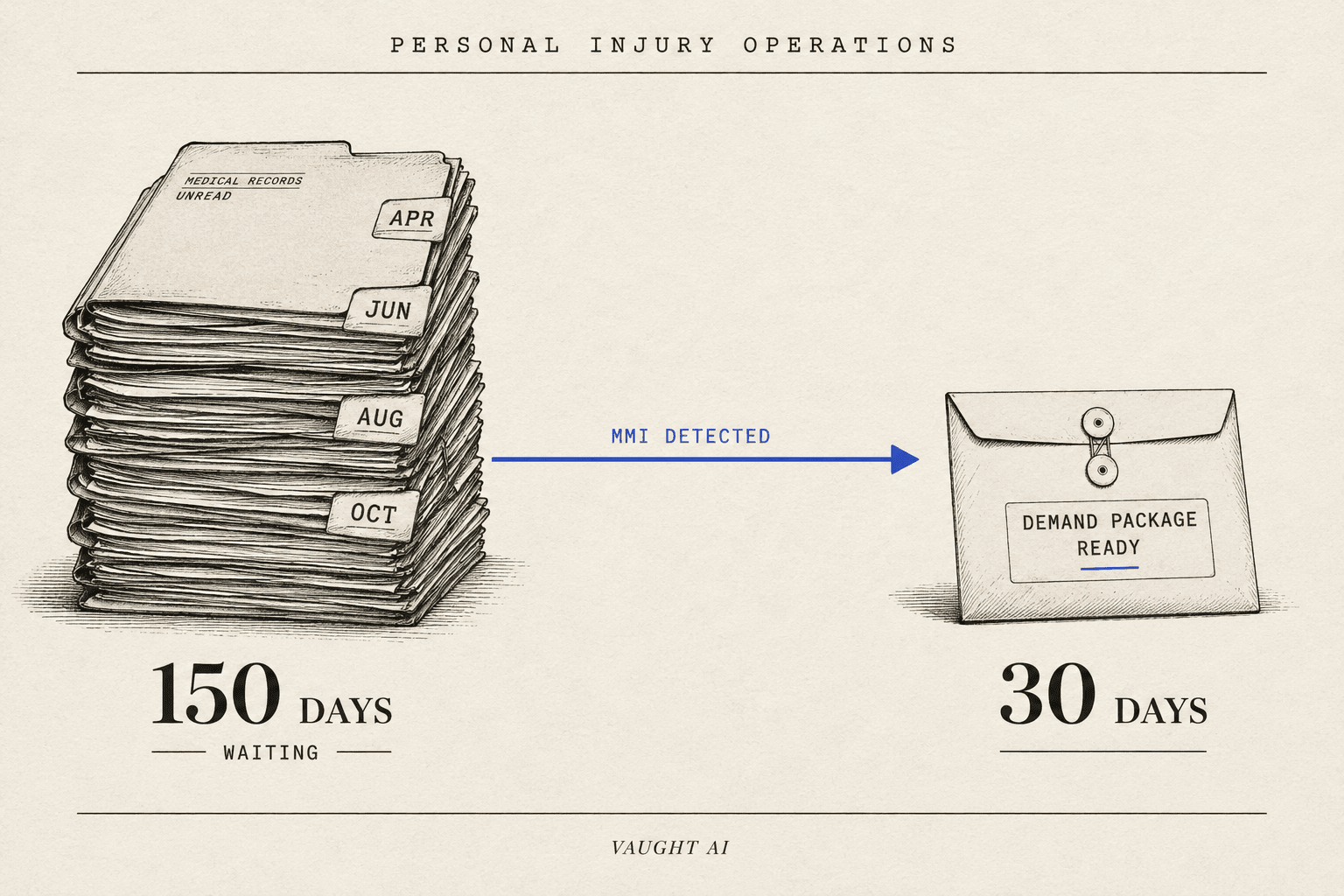
Last fall, a junior associate at a plaintiff PI firm posted in r/Lawyertalk: "We have 47 cases sitting between MMI and demand. The senior partner says we ship demands in 30 days. The actual number is 150. I have been here 4 months and I have not seen a single demand go out under 90."
186 upvotes. 94 comments. The top reply was from a paralegal at a bigger shop: "Industry average is 150 days. Your firm is normal. EvenUp says so. That is the problem."
That thread is the PI industry in one screenshot. Everybody knows the demand cycle is broken. Everybody knows the after-hours calls are bleeding. Everybody knows the paralegals are spending half their week leaving voicemails at clinics. And yet the response from most vendors is to build a better drafter (EvenUp, Supio) or a prettier case management system (Filevine, Litify, CASEpeer) instead of fixing the workflow underneath.
This post is for the plaintiff PI owner running a 3 to 25 attorney firm who reads "AI for lawyers" headlines and wonders which slice of it actually moves money. Not the AI Overviews that summarize the same vendor blog posts. Not the consultants quoting from EvenUp's marketing deck. The four bottlenecks where AI quietly fixes the dollar leak while you are in trial, the order to roll it out, and the math on the after-hours intake floor for a typical $2.5M plaintiff shop.
AI cannot try a case. It cannot read a jury. It cannot get the adjuster on the phone at 4:55 PM on a Friday. But it can stop you from leaking the calls that turn into signed cases, the records that turn into MMI signal, and the demand packages that pay for the next case. That is the framing this post runs on.
The 30-second answer
AI for personal injury lawyers, in practical terms for a 3 to 25-attorney plaintiff firm, is not one product. It is four workflow agents that sit on top of your existing case management system (Filevine, Litify, CASEpeer) and fix the four specific bottlenecks where the dollar leaks live: after-hours intake voice (40 to 60 percent of after-hours calls go to voicemail; the leak is six figures a year on a 5-attorney firm), medical records chase (paralegals spend 8 to 10 hours a week leaving voicemails at clinics), MMI detection (MMI is Maximum Medical Improvement — the point in treatment where the patient is as recovered as they will get; the industry-average 150 days from MMI to demand sent is a detection lag, not a drafting lag), and demand assembly (either feed cleaner inputs to EvenUp or Supio, or draft in your firm's own voice from your last 200 demands).
AI does not replace your paralegals, your intake CSRs, or your attorneys. It replaces the answering service you are paying $1,200 a month to fail at your job, the records death march that eats your paralegal's mornings, the 4-month MMI detection lag, and the 5 of 10 documents missing from your demand package at sign. The case strategy, the client conversation, the settlement negotiation, the courtroom presence: all still human.
For a 5-attorney firm doing $2.5M, the conservative dollar floor across the four workflows is +$500K to $1M a year in signed-case revenue and settlement-value lift, plus 200 to 400 paralegal hours recovered without hiring (Vaught AI estimates from the per-workflow math in the PI industry playbook, conservative against industry benchmarks). The rest of this post breaks down each bottleneck, the math, and the order to roll it out.
The four bottlenecks AI actually fixes for plaintiff PI
Most "AI for law firms" content lists 20 use cases and ranks them alphabetically. Half of them are document summarization that ChatGPT already does for free. Here are the four worth your money, ordered by the size of the dollar leak.
1. The after-hours intake leak
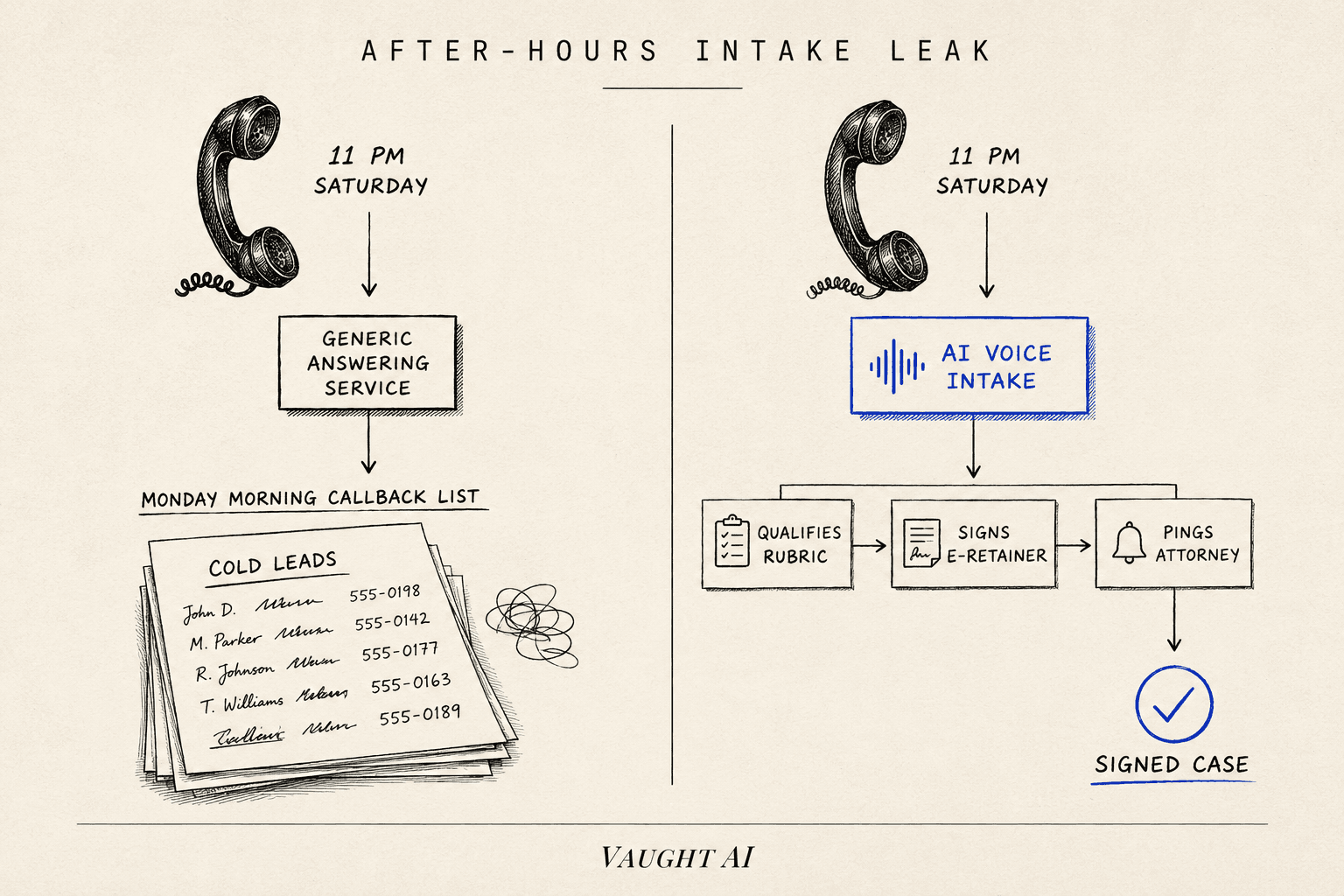
PI calls do not come in at 2 PM Tuesday. They come in at 11 PM Saturday after a wreck. They come in at 6 AM Sunday from a hospital bed. They come in during the third quarter of the Thunder game. 40 to 60 percent of after-hours PI inquiries go to voicemail (r/VoiceInfra 2025), and by Monday morning that prospect has already signed with the firm down the street that picked up first.
Generic answering services (Smith.ai, Lex Reception, Ruby) take messages. They cost $300 to $1,200 a month. They do not qualify on your case-acceptance rubric. They do not run a statute-of-limitations check or pull insurance coverage data. They do not sign e-retainers. They give you a callback queue on Monday morning, by which point the lead is cold and probably signed somewhere else.
A trained voice agent is a different category of product. It answers on the second ring, qualifies the caller on your actual rubric (mechanism of injury, SOL window, insurance coverage, treatment status), signs the e-retainer right there on the call for green leads, pings your phone for borderline cases, and hangs up politely on junk (slip-and-falls outside SOL, low-value soft-tissue without imaging, prior reps already engaged).
We built a voice intake agent for Noble Fire & Safety on the same architecture. Their booking rate on after-hours emergency calls went from a Monday-morning callback hustle to same-day dispatch with a signed work authorization. The PI shape is structurally identical with different qualifying questions.
For a plaintiff PI firm doing $2.5M, the conservative math: 4 missed after-hours calls a day × 22 work days × ~7 percent sign rate × $8,500 average signed-case revenue (loaded for cycle time and net fee) = roughly $52,000 a month in soft revenue leak. A voice agent that recovers even 50 percent of that pays for itself in the first 10 days of any month.
2. The records death march
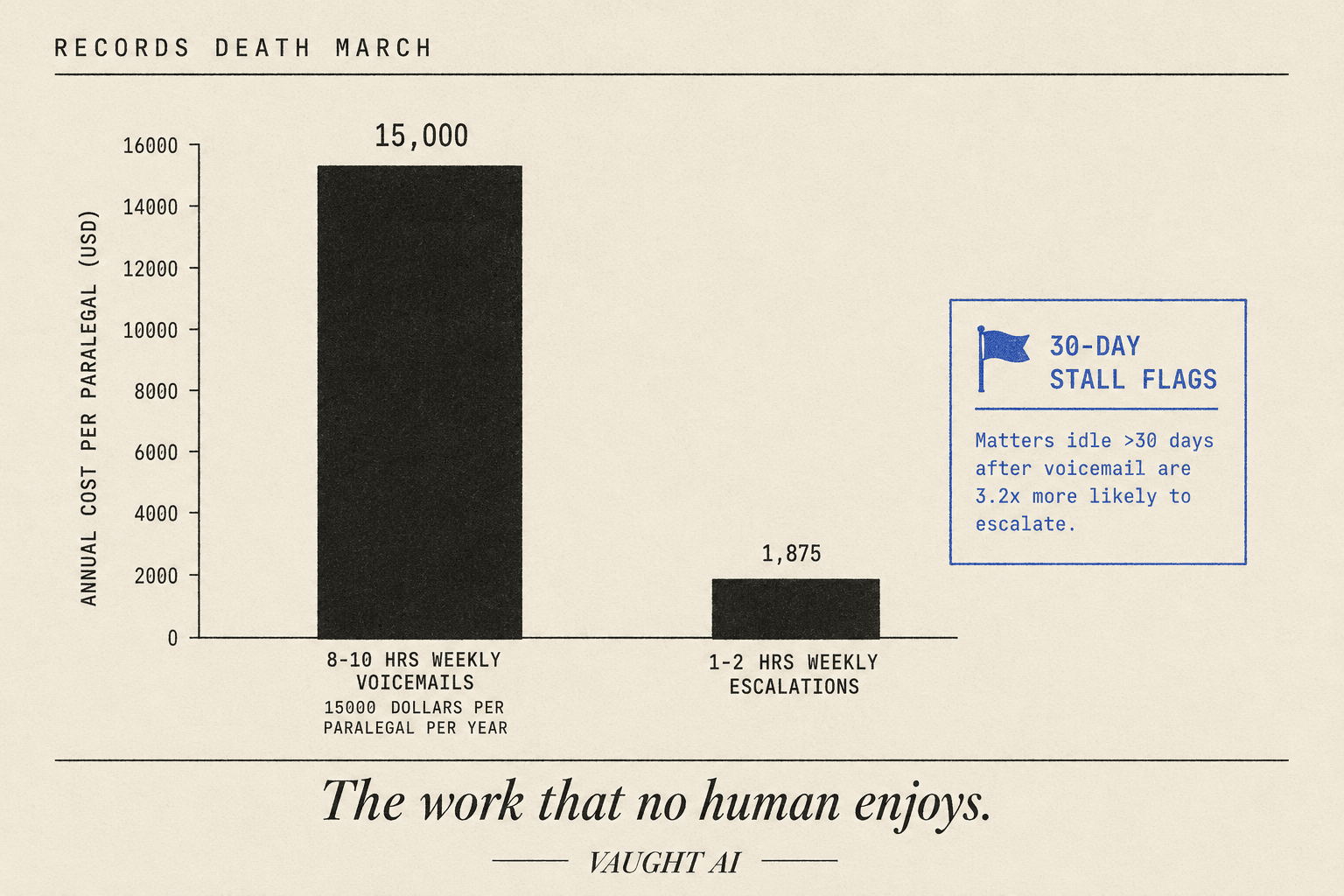
Your paralegals spend 8 to 10 hours a week leaving voicemails at hospitals, urgent cares, orthopedic clinics, chiropractors, and PT offices. The records request goes out, the clinic does not respond, the paralegal calls every week to ask if they got it, the clinic says they will call back, they do not, the paralegal calls again. Three to four months per provider on average. Multiply that by 50 active files and 12 providers per file and you have an entire FTE doing nothing but chasing paper.
The math is brutal. $30 an hour × 10 hours a week × 50 weeks = $15,000 a year per paralegal just to leave voicemails at clinics. For a 5-attorney firm with 3 paralegals, that is $45,000 a year in payroll burning on a workflow that ends with the same outcome no matter who runs it.
A HIPAA-aware voice agent does this work better than a human. It calls every active provider on a weekly cadence. It works the IVR phone tree, presses the right extensions, leaves voicemails in the correct format, logs status to your case management system, and flags any provider that has stalled 30 days or more so a human can escalate. The paralegal stops being the records-chase machine and starts being the paralegal you actually hired her to be (substance, demand prep, client narrative, case strategy).
This is the same shape we deployed for Meridian Shield, a metal fabrication client. The work was different (quote chasing instead of records chasing) but the pattern was identical: a recurring outbound voice task that no human enjoys, that breaks if a person leaves, and that the firm cannot scale without hiring more humans to leave more voicemails. We took it off the payroll and gave the paralegal her mornings back.
3. MMI detection (the silent killer of cycle time)
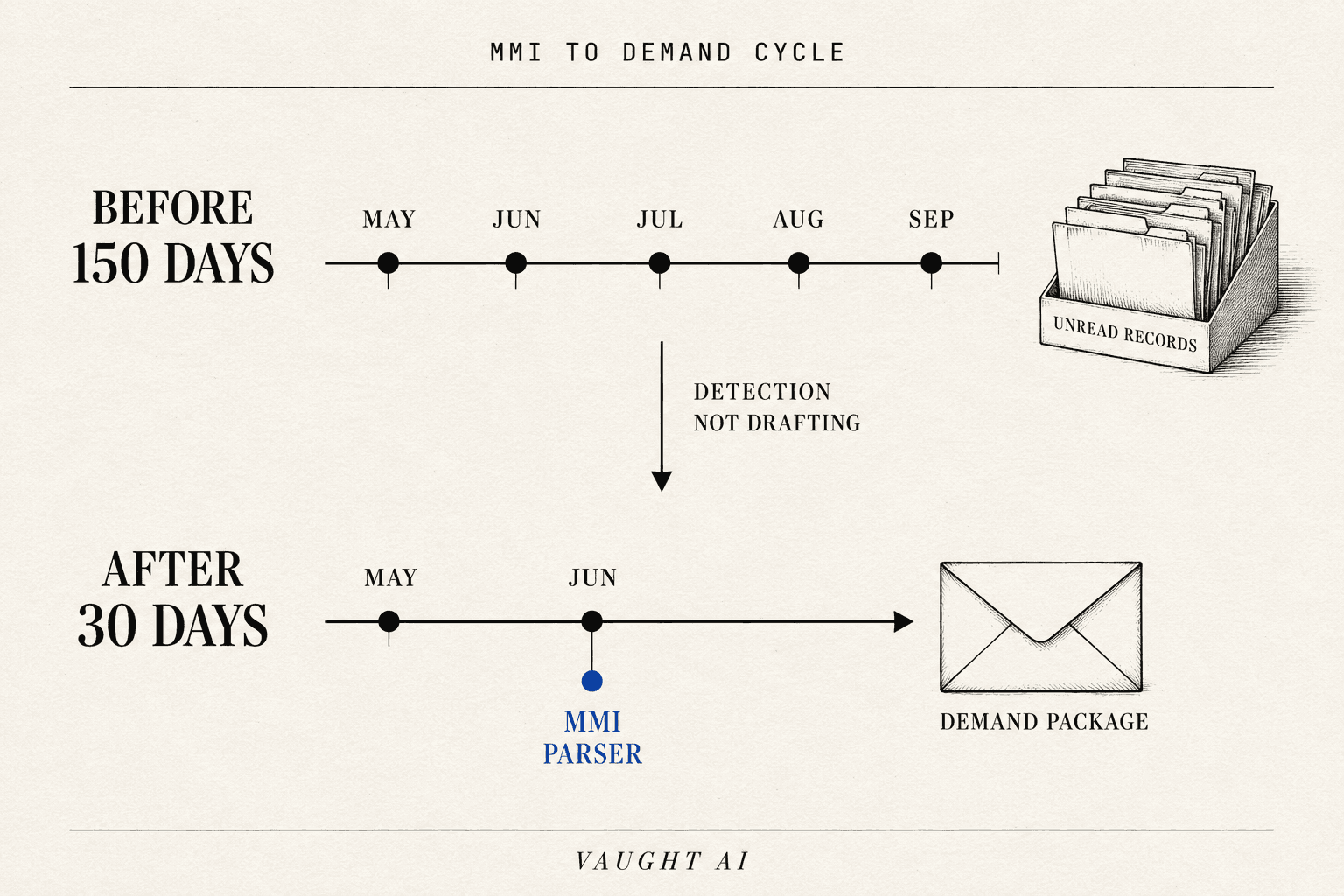
Industry average from MMI to demand sent: 150 days. EvenUp's 2025 Express Demands report calls it out. Most firms accept it as the cost of doing business. It is not. It is the symptom of a missing workflow.
Here is what actually happens. Records arrive in batches from 8 providers. The paralegal does not have time to read all 200 pages the day they land. They get filed into the case folder. Two weeks later, the paralegal pulls the file to chase the next provider. Two weeks after that, someone realizes the orthopedic visit on page 47 of the latest batch was the MMI determination (Maximum Medical Improvement). The case has been sitting in the demand queue for a month without anybody knowing it was ready.
The detection lag is the killer. The drafting itself is not the bottleneck (you can buy that from EvenUp or Supio or Filevine's in-house drafter for $200 to $500 a case). The bottleneck is knowing the case is ready to draft.
An MMI parser is a small piece of code that reads every records batch the moment it arrives. It classifies each document by type (intake note, MRI report, surgical op note, PT discharge, IME, MMI determination, return-to-work release). It tags the case file with the milestone the moment the milestone is in the file. The demand-prep workflow fires the next morning. The paralegal walks in to a case that is already on the demand queue, with records inventory pre-completed and missing items flagged.
Cycle time impact on a 5-attorney firm doing $2.5M with ~125 active files: cutting MMI-to-demand from 150 days to 30 days releases roughly $300,000 to $500,000 a year in NPV from settlements landing 4 months earlier on the case-cost float. Same case mix. Same average value. Just faster money.
4. Demand assembly without losing the firm's voice
Demand assembly is 8 to 15 hours of senior attorney and paralegal time per case. EvenUp ($2B valuation) and Supio compete head-to-head on this layer, charging $200 to $500 a case to draft from a records dump in 24 to 48 hours. For a firm sending 200 demands a year, that is $40,000 to $100,000 in vendor fees plus the human review time on the back end.
There are two honest paths here, and the right one depends on your firm.
Path A: keep EvenUp or Supio, feed them cleaner inputs. The reason EvenUp's drafts come back needing 4 hours of attorney review is that the input data is incomplete. Half the records are still pending. Three providers were never billed. The wage-loss documentation is missing. The drafter generates a draft against whatever it has, and the attorney spends the back half of the review filling in the missing pieces by hand. A records-inventory checker that runs before you submit to the drafter (completeness percent, missing documents flagged, billing data reconciled) cuts attorney review time by 50 to 70 percent without changing the drafting layer at all.
Path B: draft in your firm's own voice from your prior demands. The reason firms hesitate to use EvenUp is that the drafts come out sounding like EvenUp. The same headers. The same paragraph rhythm. The same demand-of-art rhetoric. Some firms prefer to keep their voice and pay for that distinction. A custom drafter trained on your last 200 demands writes in your firm's house style, leans on your firm's argument structures, and emphasizes the case theory the senior partner actually uses at trial. The build cost is one-time. The per-case cost after that is your AI inference (~$2 per demand) instead of EvenUp's ~$300.
Most firms doing $1M to $5M end up on Path A with the records inventory layer. Most firms over $5M with a strong house style end up on Path B with the custom drafter. We have built versions of both. The shape that works for your firm is the 30-minute conversation, not a vendor proposal.
Will AI replace your paralegals, intake CSRs, or attorneys?
No. Same answer as every other vertical we have looked at. The most upvoted r/Lawyertalk thread from 2024 said it cleaner than I can: "The day AI deposes a hostile witness is the day I retire. That day is not in 2026."
PI is insulated from displacement because the work is relational, the diagnostics are sensory (reading the adjuster's tone, reading the jury), and the trust transfer between client and lawyer is the product. AI does not sit at the kitchen table with a widow and her three kids and explain how a third-party uninsured motorist claim works.
What AI does replace is the after-hours answering service you are paying $1,200 a month to fail at your job, the paralegal's first hour every morning leaving voicemails at clinics, the silent 4-month MMI detection lag, and the 5/10 documents missing from your demand at sign. Those are the jobs AI takes off your team's plate. The case strategy, the client conversation, the trial prep, the cross-examination, the settlement negotiation, the courtroom presence: all human.
Reframe the conversation with your team this way. AI is not coming for the intake CSR's job. AI is coming for the part of her job that starts at 6:45 AM with three voicemails to chase and ends at 5:15 PM with a callback list she will never get through. The CSR keeps her job. She just gets a Tuesday morning that does not start in the hole.
The hidden math on missed PI calls
Most PI owners feel the after-hours pain. Few have done the math. Here is the floor.
Industry numbers. Average plaintiff PI signed-case revenue (loaded across the mix from soft tissue to surgical to wrongful death, net of cycle time and contingency split): $7,500 to $12,000 per signed case for a typical OK or TX firm in 2026. Conservative average: $8,500. Sign rate on a qualified inbound: 25 to 35 percent at a well-run firm. Sign rate on a missed-then-callback inbound: 5 to 10 percent (the prospect has already shopped the next two firms on Google).
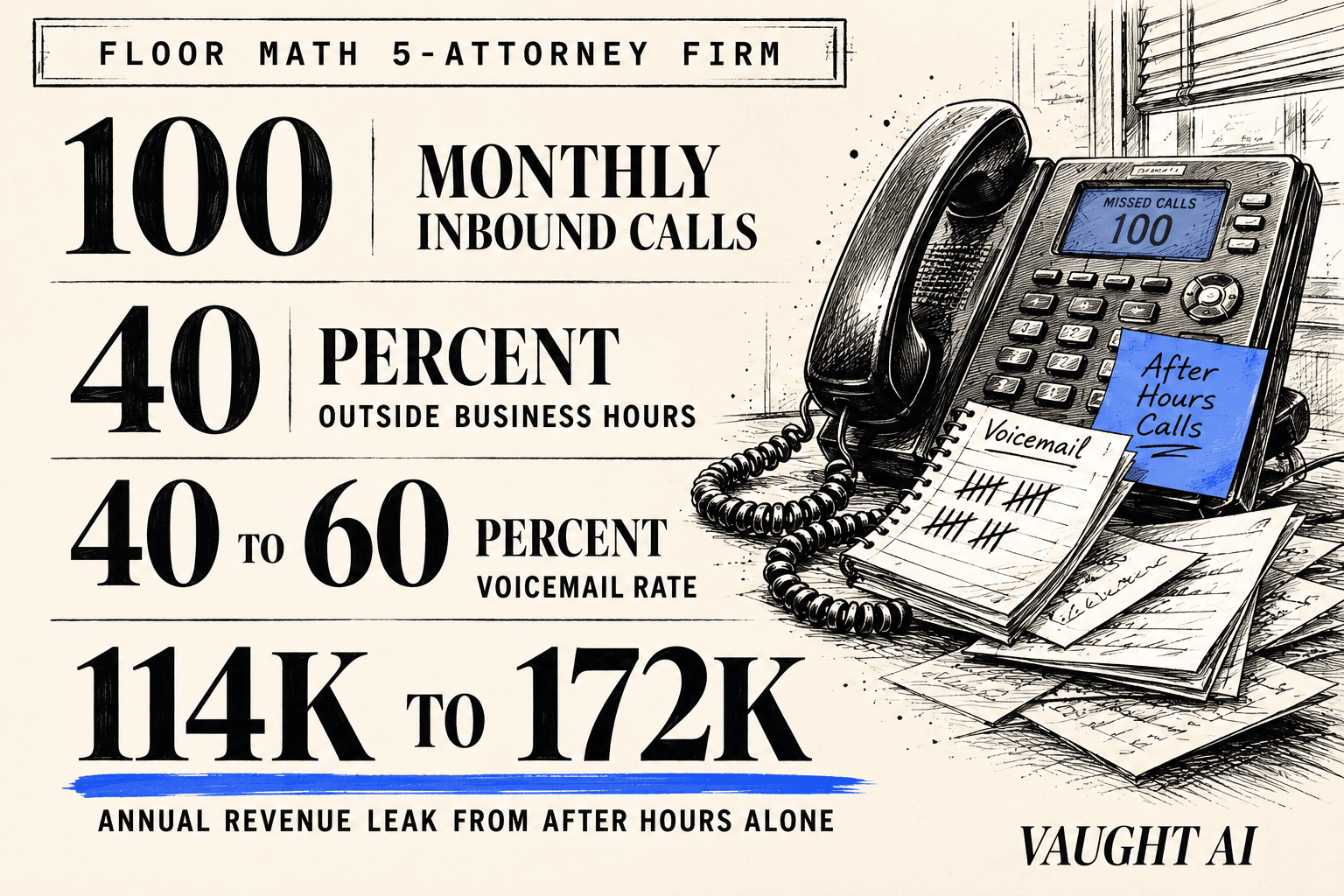
A 5-attorney shop typically takes 80 to 120 inbound qualifying calls a month across all hours. 30 to 50 percent come outside business hours. At 40 percent of 100 = 40 after-hours calls a month. 40 to 60 percent of those go to voicemail = 16 to 24 missed calls. At 7 percent sign rate (the depressed callback number, not the live-pickup number) × $8,500 = $9,500 to $14,300 a month in revenue that walked. Annualized: $114,000 to $172,000 a year just from the after-hours leak.
That is conservative. The real number for most firms is higher because the math compounds. A signed case at the top of the funnel feeds the records-chase pipeline, which feeds the MMI detection layer, which feeds the demand pipeline, which feeds the settlement queue, which feeds the next case-cost float. Plug the leak at intake and the entire downstream stack benefits 6 to 12 months later.
A trained voice intake agent realistically recovers 60 to 80 percent of the after-hours leak. Even at the floor of that range, you are looking at $70,000 to $130,000 a year in recovered signed-case revenue for a tool that costs less than a third of a paralegal's loaded salary.
What about Filevine, Litify, CASEpeer, and EvenUp?
Honest answer: if you have one, keep it. They run your case data, your dispatch board for paralegal assignments, your settlement-ledger reporting. We do not replace any of that.
What they do not do, and what nobody is shipping for them in the next 18 months: they do not answer after-hours intake calls and sign e-retainers. They do not chase medical providers on a weekly outbound voice cadence. They do not read incoming records and detect MMI the day it lands. They do not draft your demand in your firm's voice from your last 200 demands.
Filevine runs $50K to $80K a year for a 5-attorney firm. Litify is on the same shelf. CASEpeer is more modest at $5K to $15K. EvenUp charges $200 to $500 per demand drafted. None of those vendors are competing with each other on the workflows we just covered. They are great at what they were built for. They were not built for the parts AI now solves.
For firms under $5M, the cheapest move is a custom workflow layer that sits on top of your existing CMS and fits your actual rubric, your actual rep pool, your actual records-request templates. We do not replace Filevine. We add the four workflows Filevine was never built to run. That layer costs less to build than the difference between the Filevine renewal and CASEpeer's base tier.
For firms over $10M, the calculus shifts. The integration math starts to work for the FSM-native AI inside the bigger CMS platforms (Litify's AI suite, Filevine's Sidebar). At that scale, the platform tax is small relative to the workflow value, and the integration work is already in their roadmap. Below $10M, the platform tax dominates and the custom layer wins.
How to start: the order operations actually fix things
Do not try to turn on four AI workflows in the same month. The order that works:
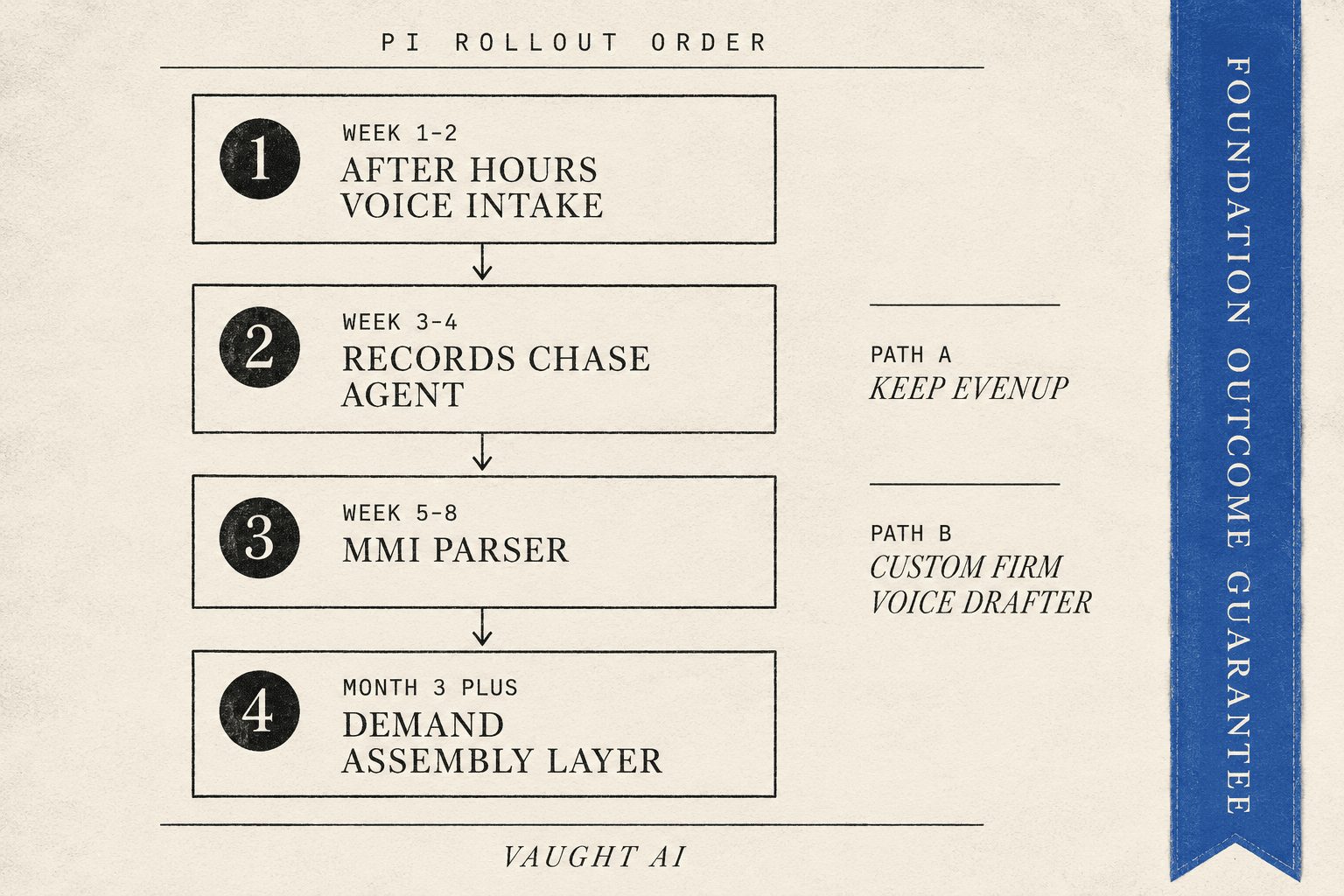
Week 1 to 2: Plug the after-hours leak first. Voice intake agent answers everything inbound after 5 PM and on weekends. Two-week pilot. Watch the booking rate and the sign-rate-on-qualified delta. This is the biggest dollar leak and the cleanest win.
Week 3 to 4: Wire the records-chase voice agent. Weekly cadence on all active providers across all active files. HIPAA-aware. Logs to your existing CMS. Frees 8 to 10 hours per paralegal per week immediately.
Week 5 to 8: Deploy the MMI parser on incoming records. Classifies milestones the day they land. Triggers the demand-prep workflow on detection. This is where cycle time compresses.
Month 3 onward: Stand up the demand assembly layer. Either the records-inventory checker (Path A, if you keep EvenUp or Supio) or the firm-voice custom drafter (Path B, if you want to own the layer outright). Decision depends on your firm style and your demand volume.
We package this as a Recovery Blueprint engagement. Foundation Outcome Guarantee: your first AI workflow is live in 30 days, or we do not bill the retainer. Built around your case-acceptance rubric, your CMS, your records-request templates, your demand voice. Not generic.
A note on privilege, ethics, and where the lines actually are
Three months ago, a federal judge in the Southern District of New York ruled that AI chats between attorneys and consumer chatbots are not protected by attorney-client privilege when the chatbot is operated by a third-party vendor (Heppner, May 2026). The ruling does not change how PI firms can use AI internally. It does change which AI you can pour client data into.
The short version. Anything you type into ChatGPT, Claude.ai, Gemini, or any consumer LLM gets used by that vendor according to their terms of service. For most firms in 2026, that is enough to make putting privileged matter into consumer chat a malpractice question, not a tech question. The fix is private AI infrastructure (your data stays in your environment, no vendor training, no consumer terms of service). The same architecture pattern applies to every PI build we ship.
For the workflows in this post: the voice intake agent runs on your stack with your data. The records-chase agent calls clinics from your firm's phone numbers and logs back to your CMS. The MMI parser reads records inside your environment. The demand drafter trains on your prior demands and runs in your environment. No consumer chat involved at any layer. Privilege stays where it belongs.
Frequently asked questions
How is this different from EvenUp or Supio?+
EvenUp and Supio draft demands. They are good at it. They are not built to answer after-hours intake calls, chase medical records on a weekly outbound voice cadence, or detect MMI from incoming records the day it lands. We build the four workflow layers that feed inputs to drafters like EvenUp (or replace them with a firm-voice custom drafter if you prefer to keep the layer in-house).
Do I have to replace Filevine, Litify, or CASEpeer?+
No. The workflows we build sit on top of your existing CMS and write back to it. Voice intake signs the e-retainer and creates the matter in Filevine. The records-chase agent logs status to the CMS case file. The MMI parser tags the milestone in the case record. The demand drafter pulls inputs from CMS data. Your team still works in the system they already know.
Is voice intake AI HIPAA-compliant?+
Yes when it is built right. We deploy on infrastructure that ships with signed BAAs (Business Associate Agreements), audit logging on every call transcript, encryption at rest and in transit, and PHI handling that meets the same standard as your CMS. The trap is the cheap consumer voice agents that do not offer BAAs. Those are not deployable for PI intake. We do not use them.
How much does this cost to build?+
For a 5-attorney plaintiff PI firm, the typical engagement is $15,000 to $35,000 in build cost spread over 8 to 12 weeks, plus a monthly retainer ($799 to $1,499) covering ongoing support, model upgrades, and workflow tuning. The full four-workflow rollout pays for itself in the first quarter on after-hours intake recovery alone. The cycle time compression and paralegal capacity gains compound from there.
Can the voice agent sign e-retainers on the call?+
Yes for green leads that pass your case-acceptance rubric on the call. The agent sends an e-signature link via SMS to the prospect mid-call, walks them through the retainer terms, captures the signature, and creates the matter in your CMS before the call ends. For borderline cases the agent escalates to your phone or queues a callback in business hours. For obvious junk it hangs up politely.
What happens if the AI gets a qualification call wrong?+
Two layers of safety. First, the rubric is conservative by default. Borderline cases escalate to an attorney, not sign. Second, every call is transcribed, logged, and reviewable. If a signed case turns out to be one you would not have signed, you spot the pattern in the next weekly review and tighten the rubric. The same review surfaces cases that were declined but should have been escalated. The rubric improves monthly.
Will this work for a solo practitioner?+
The math gets tighter under 2 to 3 attorneys. After-hours intake voice still pays back fast (the leak is structural, not size-dependent). The records-chase agent pays back below 25 active files. The MMI parser and the demand drafter make more sense at 75+ active files. A solo with 20 to 50 active cases is usually a voice-intake-only engagement for the first 6 months.
Can we keep our existing intake CSR?+
Yes, and most firms do. The voice agent covers after-hours and overflow during business hours when the CSR is on another call. The CSR handles live business-hour intake at the standard human conversion rate. The two work in parallel. The CSR is not replaced. She just stops eating Monday morning trying to chase the weekend voicemails.
See the playbook in action
Two real client builds anchor the workflows in this post. Different verticals, same architectural pattern.
Voice intake and same-day dispatch, Noble Fire & Safety: zero missed inspections since the switch, 5+ hours saved per tech per week, mobile-first PWA that works offline in mechanical rooms. The voice intake architecture ports directly to PI with different qualifying questions.
Velocity workflow, Meridian Shield: quote time dropped from 60 minutes to under 5 minutes, 3x quote capacity, zero material miscalculations. The same shape applied to demand assembly cuts senior attorney review time from 4 hours to under 1.
For the full plaintiff-PI gap map (five workflow agents, the 150-day cycle math, the ROI breakdown on a 5-attorney firm), see the Personal Injury Lawyers industry playbook.
Joey Vaught, Founder, Vaught AI.
30 min. We walk through your firm, map the four bottlenecks against your case load, name the dollar floor on each leak, and show you which workflow to plug first. Foundation Outcome Guarantee: your first automation is live in 30 days, or we do not bill the retainer.