Last spring, a fire protection owner posted in a private NFPA contractor forum: "We just got hit with a $4,800 AHJ fine because an annual sprinkler inspection at a strip-mall property dropped through the cracks. My ops manager swears she had it on the spreadsheet. We pulled the spreadsheet. The row was there. The reminder column was blank. Two pages over there is the same building from 2024 marked complete. Nobody updated the 2025 cycle. Now I owe the city $4,800 and the property manager is talking to my competitor."
Eighteen replies. Every reply was a variation of the same story. Different city. Different code section. Same root cause: the calendar lives in somebody's head or in a spreadsheet that breaks the moment somebody leaves the company.
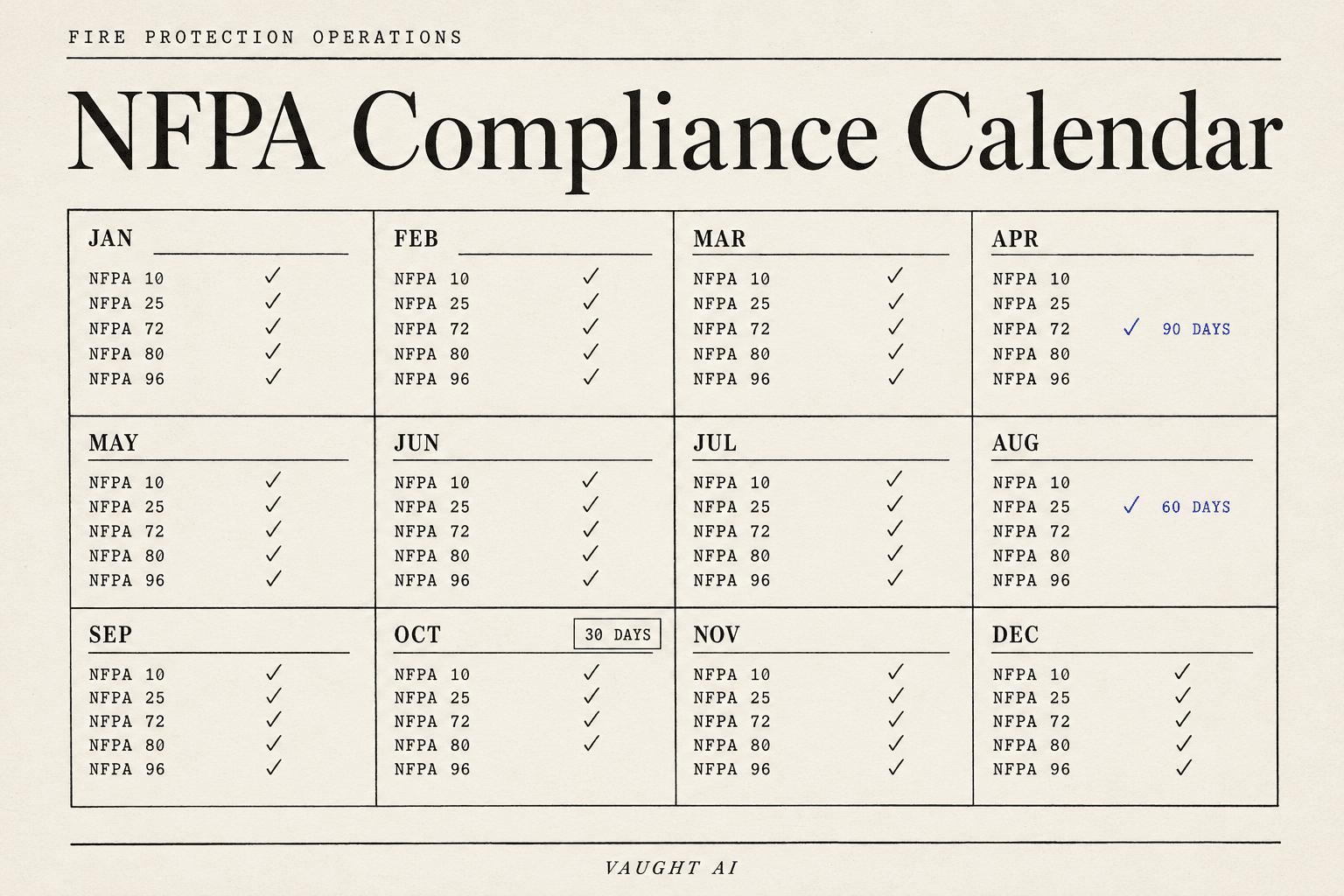
That thread is the fire protection industry in one screenshot. NFPA frequencies are deterministic. The math is simple. Every asset has a code-mandated cadence (NFPA 10 for extinguishers, 25 for sprinklers and standpipes, 72 for alarm systems, 80 for fire and smoke dampers, 96 for kitchen suppression). A computer should never miss one. And yet missed inspections are the single most common AHJ fine in the industry, costing $500 to $5,000 per violation plus daily stacking penalties (California H&S Code §13112), and that is before you count the lost recurring contract revenue and the property manager who quietly switches vendors.
This post is for the fire protection owner running a 5 to 50-truck shop who keeps reading "AI for trades" headlines and wonders which slice of it actually moves money. Not the AI Overviews that summarize Inspect Point's marketing blog. Not the consultants quoting from BuildingReports' product deck. The four bottlenecks where AI quietly fixes the dollar leak while you are on a roof in 96-degree heat, the order to roll it out, and the math on the deficiency quoting floor for a typical 10-tech shop.
AI cannot crawl an attic to test a heat detector. It cannot diagnose a wet-pipe air-gap. It cannot have the awkward conversation with a property manager about replacing twelve sprinkler heads on a third-floor tenant suite. But it can stop you from leaking the deficiency quotes that turn into your second highest revenue line, the after-hours panel trouble calls that turn into emergency dispatches, and the compliance calendar that turns into AHJ fines while you are nursing a beer on Saturday.
The 30-second answer
AI for fire protection companies, in practical terms for a 5 to 50-truck shop doing $1M to $10M, is not one product. It is four workflow agents that sit on top of your existing field service management software (Inspect Point, ServiceTrade, BuildingReports, or Housecall Pro) and fix the four specific bottlenecks where the dollar leaks live: after-hours panel trouble intake (the call your competition is missing while you sleep), same-day deficiency quoting (the 30 to 50 percent of repair revenue walking from 3-to-7-day quote cycles), per-asset NFPA compliance calendar (the missed inspection that becomes a $500 to $5,000 per violation AHJ fine), and on-site reporting plus DSO compression (techs lose 5 to 10 hours a week to admin).
AI does not replace your fire techs, your dispatch CSR, or your office manager. It replaces the answering service you are paying $1,200 a month to fail at your job, the paper-and-typing report cycle that eats your office every morning, and the spreadsheet compliance calendar that breaks the moment somebody leaves the company. The AHJ relationship, the on-site judgment call, and the customer conversation: all still human.
For a 10-tech shop running 1,500 inspections a year, the conservative dollar floor across the four workflows is +$175K to $270K a year in recovered revenue and avoided losses from the compliance calendar plus the same-day deficiency quoting (Vaught AI estimates against ServiceTrade 2024 Fire & Life Safety Benchmark and Inspect Point 2025 Industry Report data). Top-half pull-through performers earn 99 percent more revenue per customer than the median; the single biggest variable that separates the two groups is how fast the deficiency quote gets to the property manager. The rest of this post breaks down each bottleneck, the math, and the order to roll it out.
The four bottlenecks AI actually fixes for fire protection
Most "AI for fire safety" content lists 20 use cases and ranks them alphabetically. Half of them are document summarization that ChatGPT already does for free. Here are the four worth your money, ordered by dollar leak.
1. After-hours panel trouble (the call your competition is missing)
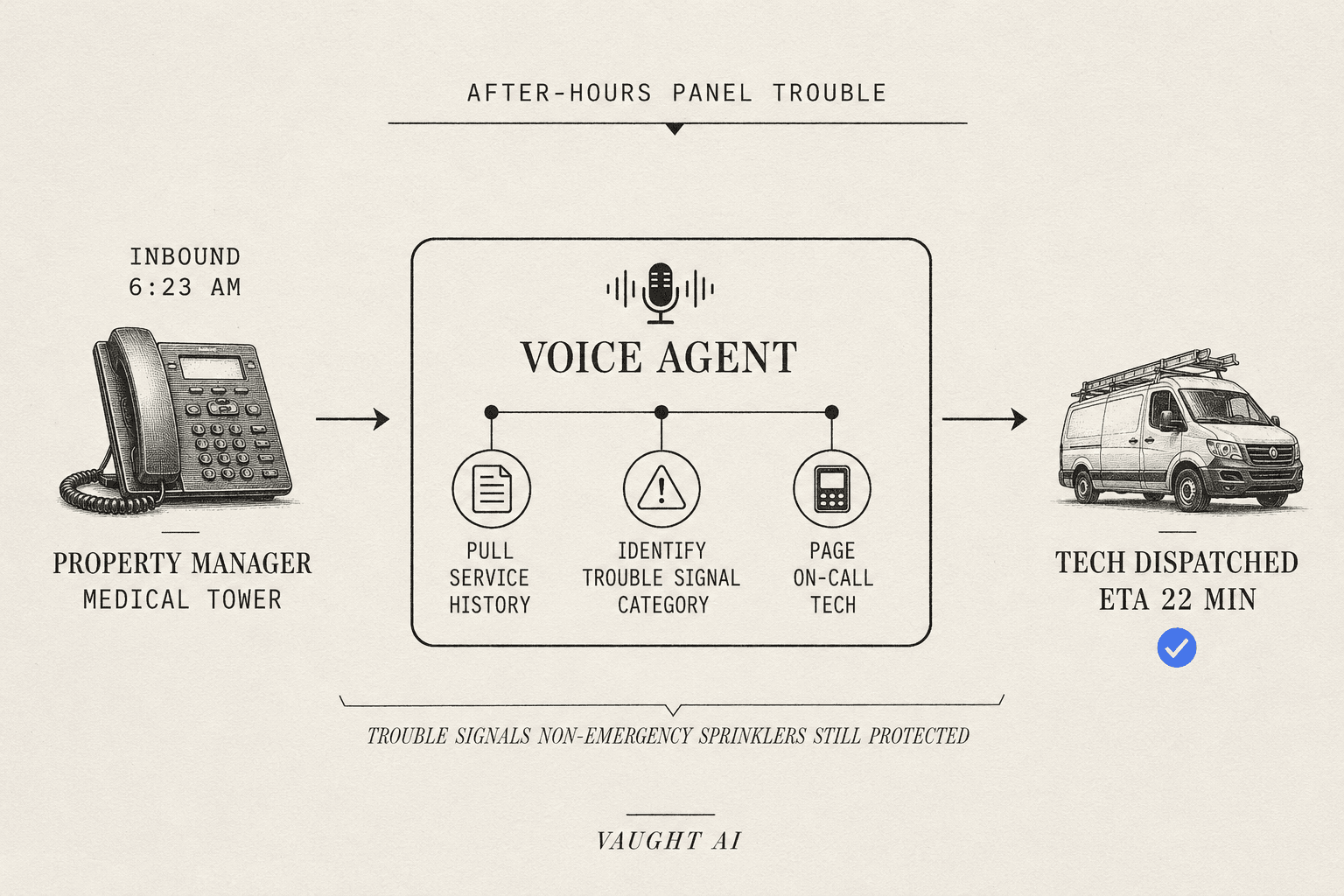
Fire panel trouble signals do not wait for the office to open. They fire at 6:23 AM Saturday when the property manager at a medical tower has forty tenants getting ready to start their day and a flashing yellow on the panel. They fire at 11:47 PM Sunday when the server room HVAC trips a feeder breaker at a tech company. They fire during the third quarter of the OU game when the kitchen suppression line at a restaurant gets a low-pressure alarm.
Most fire protection companies handle this the same way. The phone rolls to a $1,200-a-month answering service that takes a message. The on-call tech finds out about it 90 minutes later when somebody listens to the voicemail. By that point the property manager has already called two other companies. Whoever picks up first dispatches first. You finish your beer at 9 PM Sunday and find out Monday that you lost a recurring contract over a 90-minute lag.
A trained voice agent on the same architecture as the Noble Fire & Safety intake build answers on the second ring. It pulls the building's service history, identifies the alarm category (trouble versus supervisory versus active alarm), pages the closest on-call tech matched to the system type, creates a dispatch ticket, and reassures the property manager that the building is still protected (trouble signals are non-emergency, sprinklers and pull stations still work fine). All before the property manager finishes describing the alarm.
This is not theoretical. Noble Fire & Safety runs this. Their property managers stopped calling competitors because they know the phone gets answered. Their on-call rotation stopped getting blown up at 2 AM by trouble signals that could have waited until 7. Their first-call dispatch rate on after-hours emergencies went from a Monday-morning callback hustle to same-day same-hour same-truck response.
For a 10-tech fire protection shop, the conservative math: 8 to 15 after-hours emergency calls a month, 30 to 40 percent of which become competitive shopping events when the call rolls to voicemail. At $2,500 to $5,000 average emergency-response invoice plus annual recurring contract value of $6,000 to $12,000 per recovered client, the after-hours leak is $40,000 to $80,000 a year in directly billable work and another $40,000 to $80,000 in saved recurring revenue from clients you would have lost.
2. Same-day deficiency quoting (where your second revenue line lives)
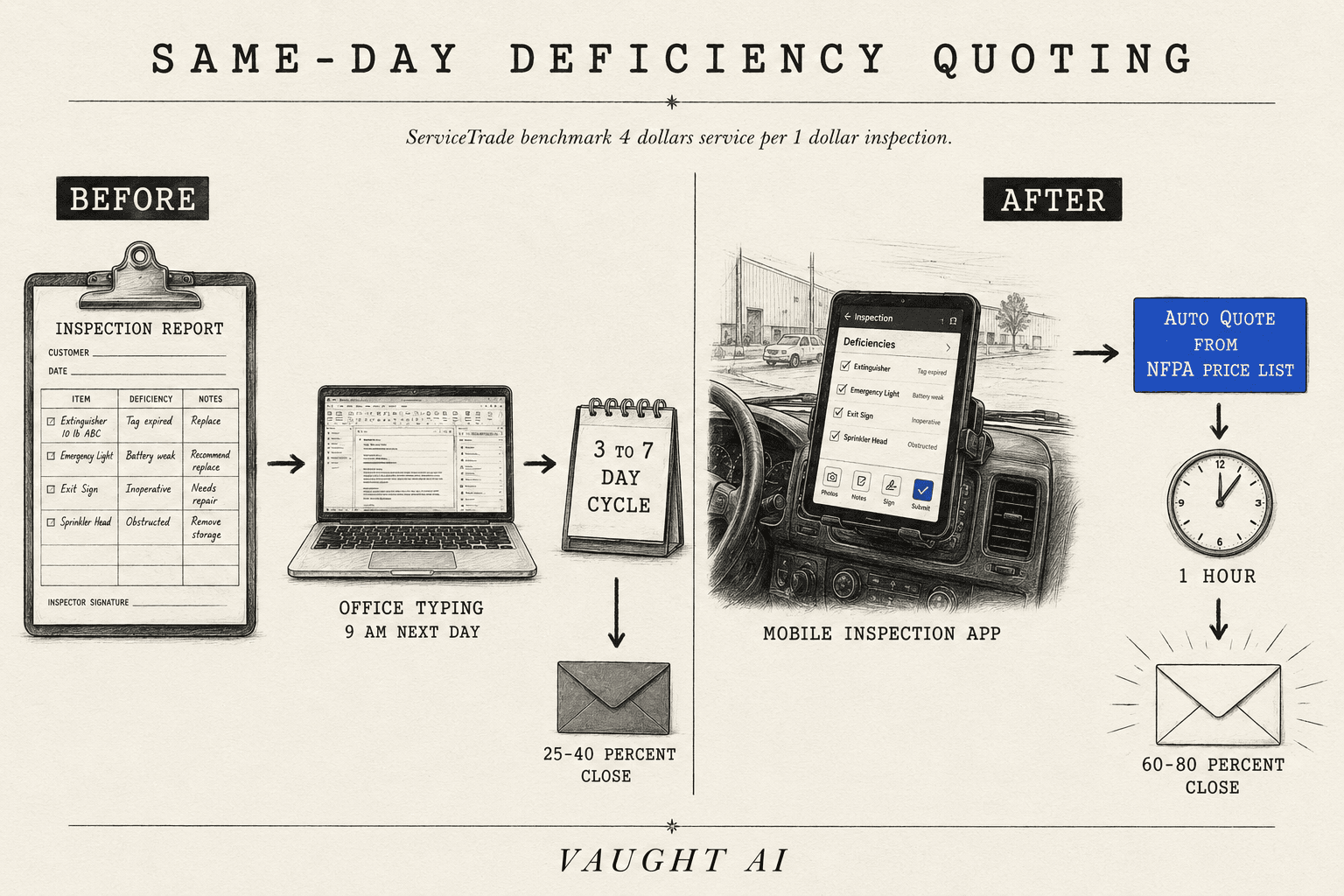
Top fire protection companies generate $4 in service revenue for every $1 in inspection revenue (ServiceTrade 2024 Fire & Life Safety Benchmark). Top-half pull-through performers earn 99 percent more revenue per customer than the median. The single biggest variable that separates the two groups is not pricing or sales technique. It is how fast the deficiency quote gets to the property manager.
The shop in the bottom half writes the deficiency on a paper inspection form on-site, drives the form back to the office at 4 PM, the office staff types it up at 9 AM the next morning, the quote gets emailed Tuesday afternoon, the property manager opens it Wednesday, sits on it Thursday and Friday, calls the cheaper guy by the following Monday. Total cycle: 3 to 7 days. Close rate on deficiency repairs in that cycle: 25 to 40 percent.
The shop in the top half writes the deficiency on a mobile inspection app that auto-populates a repair quote from the firm's NFPA price list while the tech is still on the truck in the parking lot. The quote hits the property manager's inbox within an hour. The property manager forwards it for sign-off the same afternoon. The deficiency repair gets scheduled within the week. Total cycle: 1 to 24 hours. Close rate: 60 to 80 percent.
The Noble Fire build runs this. Inspection form, deficiency flag, auto-generated quote, signature link, follow-up cadence at 3, 7, and 14 days, all from the tech's iPad on-site. The shop's deficiency revenue line grew faster than the inspection revenue line in the first six months.
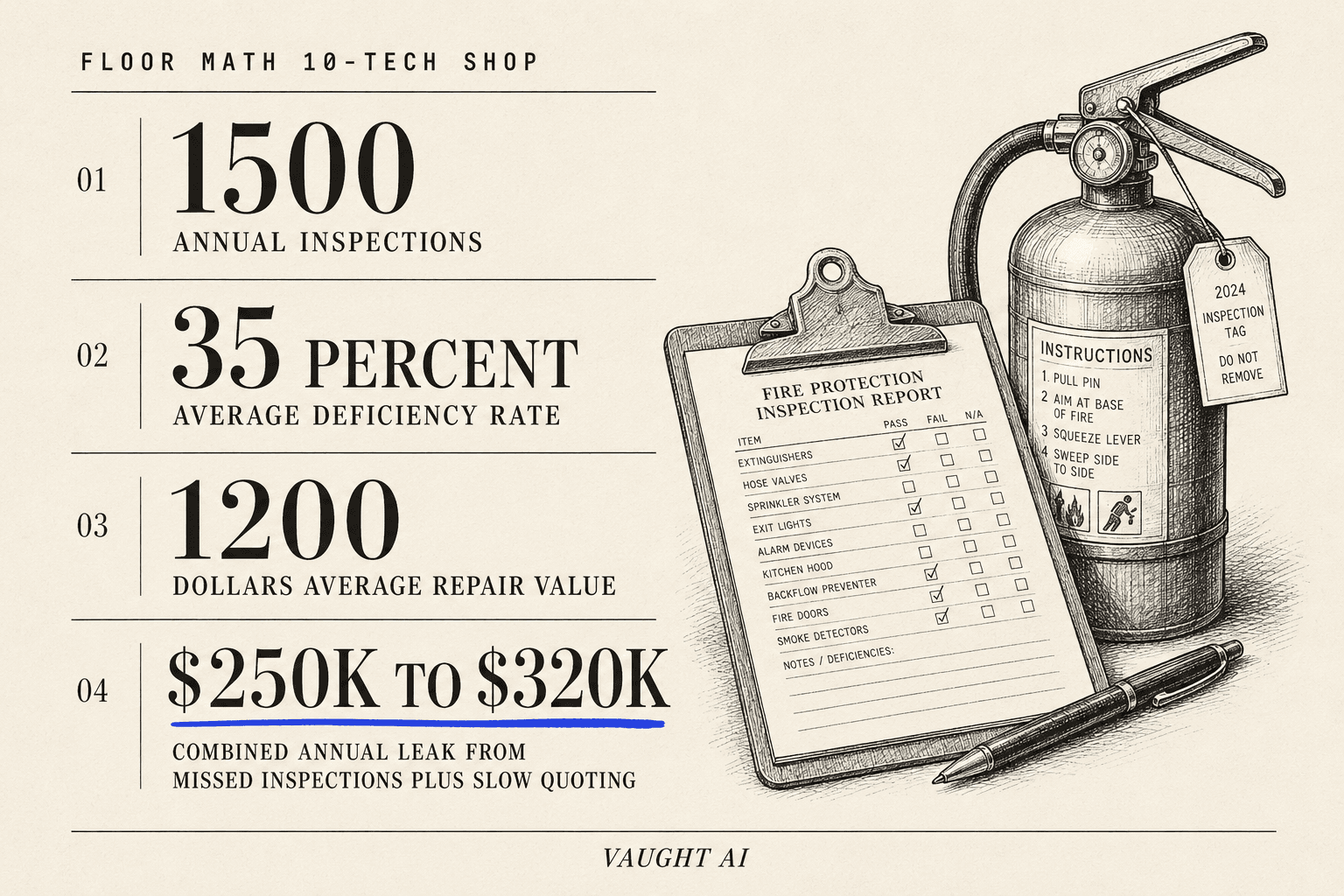
For a 10-tech shop running 1,500 inspections a year with a 35 percent deficiency rate, the math: 525 deficiency events × $1,200 average repair value × 30 to 50 percent of revenue currently leaking from slow quoting = $190,000 to $315,000 a year in deficiency revenue that walks. A same-day quoting workflow recovers 60 to 80 percent of it. That is $120,000 to $250,000 a year for a tool that costs less than half a tech's loaded hourly rate.
3. The NFPA compliance calendar (the ticking time bomb)
One missed annual inspection costs $2,000 to $15,000 in recurring contract revenue plus AHJ liability with fines from $500 to $5,000 per violation and daily stacking penalties (California H&S Code §13112; Oklahoma and Texas have similar stacking provisions). The math on a single missed cycle is brutal. The math on a pattern of missed cycles is fatal: the AHJ flags your firm, the property manager loses confidence, the renewal walks, the brand damage compounds.
Generic field service management software (Housecall Pro, Jobber, ServiceTitan in its base tier) tracks recurring jobs by date. It does not track NFPA frequencies. It does not know the difference between an NFPA 10 quarterly extinguisher check and an NFPA 25 annual sprinkler inspection. It does not know that a kitchen suppression system in a commercial kitchen needs an NFPA 96 inspection every 6 months and that the cadence resets if the system is altered or replaced. It does not know that the AHJ in Norman, Oklahoma adopted NFPA 25 (2023 edition) last year while OKC is still on the 2020 edition and Stillwater is in review.
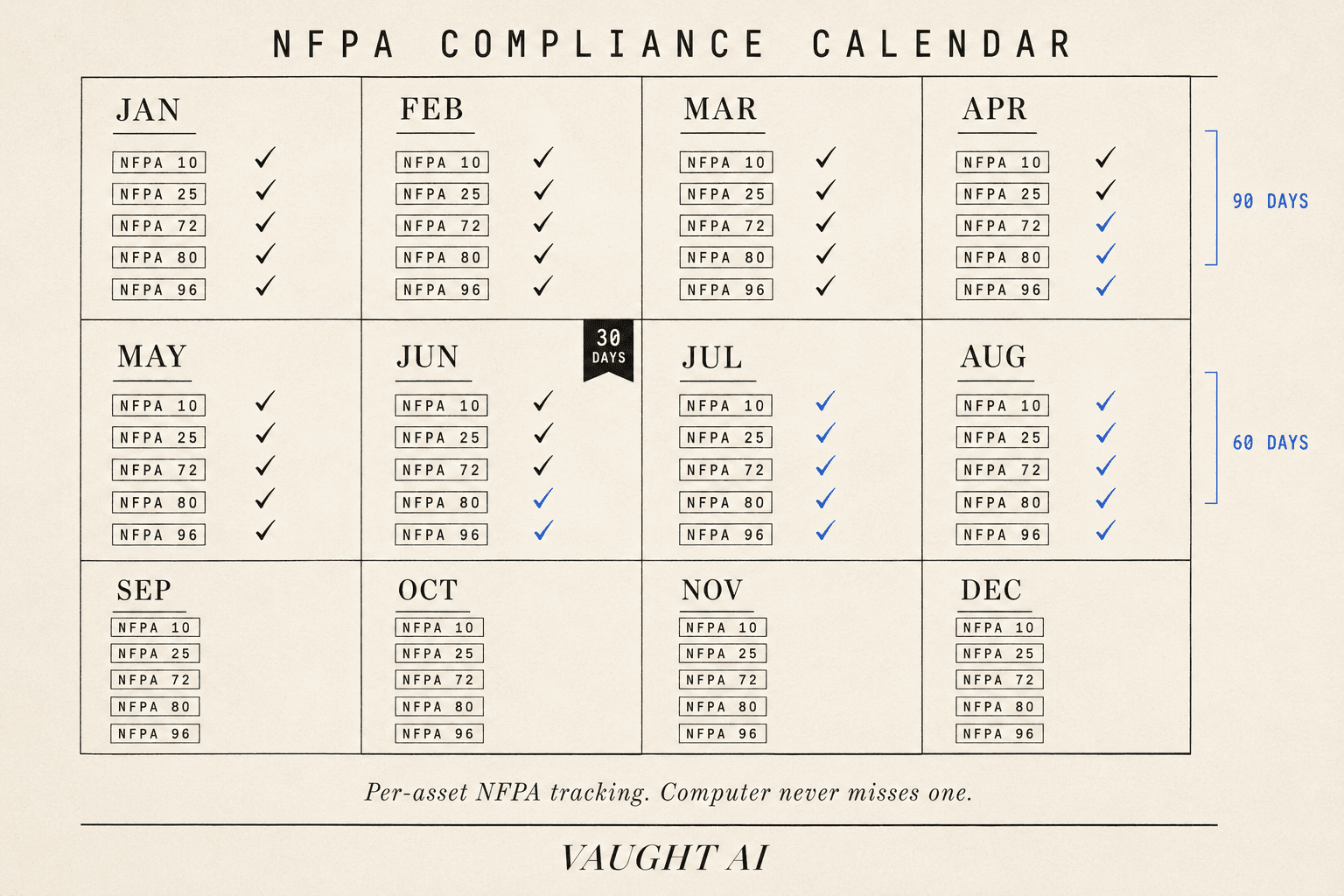
A per-asset compliance calendar that auto-calculates due dates by code section, flags 90 days out, escalates 60 days out, and triggers a re-inspection workflow 30 days out is the single highest-value piece of software you can put into a fire protection shop. Inspect Point and BuildingReports both ship versions of this. The trap is they run $150 to $300 per user per month, they assume you onboard your entire client base into their schema, and they leave gaps on niche code sections that matter for specific verticals (industrial fire protection, healthcare facility codes, military base contracts).
For a 5 to 25-truck shop, a custom compliance calendar built around your actual asset mix and your actual jurisdictions costs less than 12 months of Inspect Point at the per-user tier, and it knows your codes better. We built this for Noble. Zero missed inspections since the switch. Full per-asset NFPA tracking across 10, 25, 72, 80, and 96. AHJ pull (the "I need every report from the last 5 years on this building right now" request) takes 2 minutes instead of half a day.
4. The on-site report and the DSO compression
Fire protection techs lose 5 to 10 hours per week to admin (Inspect Point 2025 Industry Report). They handwrite the report at the site, drive back to the office, type it up, file the paperwork, generate the invoice, mail it, wait. For a 10-tech shop that is 50 to 100 hours a week of non-billable time. At $45 to $65 per loaded tech-hour, you are burning $115,000 to $340,000 a year on the admin layer.
The DSO (Days Sales Outstanding) compression layered underneath is the same magnitude. Commercial fire protection invoices typically clear at 45 to 75 days on a paper-and-mail workflow. The same invoice generated on-site, paid via tap-to-pay or emailed Stripe link, and chased by an automated reminder at 3, 7, and 14 days clears in 7 to 14 days on 60 percent of jobs. For a $2M revenue shop, that is roughly $80,000 to $150,000 in working capital freed from receivables.
The Noble build runs the entire stack. Tech taps through the inspection on the iPad on-site, the report drafts itself in the AHJ's required format before the tech leaves the parking lot, the invoice generates from the inspection data, the property manager pays on-site or via the email Stripe link, the auto-reminder cadence fires at 3, 7, and 14 days for anything still open. The tech does not drive to the office. The office staff does not type up paperwork. The cash arrives 6 weeks earlier than it used to.
Will AI replace your techs, CSRs, or office staff?
No. Fire protection is insulated from displacement because the work is physical, the diagnostics are sensory (smell of burnt wiring, pressure feel on a riser, sound of a misaligned damper), and the AHJ relationship is relational. AI does not crawl an attic at 4 PM in August. It does not have the awkward conversation with a building owner about replacing the kitchen suppression system that has been deferred three years running. It does not stand in front of a fire marshal and walk through the deficiency report.
I will tell you what I told the HVAC pillar audience and the PI pillar audience: AI replaces the answering service you are paying $1,200 a month to fail at your job, the dispatcher's first hour every morning chasing voicemails, and the office staff member typing up reports your techs already wrote on paper. The work that nobody enjoys and that nobody is required to do as a human.
Your techs get to be techs. Your CSR gets a Tuesday morning that does not start in the hole. Your office staff stops typing reports and starts running the parts of the business that need a human (vendor relationships, AHJ liaison, problem clients, parts ordering, the things actually worth their loaded hourly rate).
The hidden math on missed inspections (and lost deficiency revenue)
Most fire protection owners feel the pain on missed inspections. Few have done the math. Here is the floor.
Industry numbers. Average recurring inspection contract value: $1,800 to $3,200 per building per year. Average deficiency-rate-per-inspection: 30 to 40 percent. Average deficiency repair value: $800 to $1,500. AHJ fine schedule: $500 to $5,000 per missed inspection violation with daily stacking. Average contract loss rate when a client gets an AHJ surprise letter on your watch: 35 to 50 percent in the next renewal cycle.
For a 10-tech shop running 1,500 inspections a year across 500 buildings, the floor math on missed inspections alone: 3 missed cycles per year (conservative for a paper-and-spreadsheet workflow) × $4,000 average loss (combined fine, recurring loss, AHJ relationship damage) = $12,000 a year in direct loss. The bigger number is the deficiency revenue walking from slow quoting: 525 deficiencies × $1,200 average value × 40 percent leakage from 3-to-7-day quote cycles = $252,000 a year.
Combined leak: $250,000 to $320,000 a year on a 10-tech shop just from the compliance calendar and the deficiency quoting layer. A custom workflow stack with same-day quoting + per-asset NFPA tracking + on-site invoicing recovers 70 to 85 percent of it. That is $175,000 to $270,000 a year in recovered revenue and avoided losses for a build cost that pays back in the first quarter.
What about Inspect Point, ServiceTrade, and BuildingReports?
Honest answer: if you have one, keep it. They run your customer database, your contract billing, your standard NFPA frequencies, your AHJ-format report templates. We do not replace any of that.
What they do not do well, in our experience and in the brutal threads we read in private fire protection forums: they leave the workflows that move the most money (after-hours intake voice, on-site deficiency quoting in the firm's own voice, jurisdiction-specific code variants, custom asset types like industrial fire protection or healthcare-facility codes) as either bolt-on add-ons at $50 to $150 per user per month or as gaps you fill with a side spreadsheet that defeats the point of having FSM software at all.
Inspect Point and BuildingReports both run $150 to $300 per user per month at the inspection tier. ServiceTrade runs $80 to $200 per user per month. For a 10-tech shop with office staff, that is $25,000 to $60,000 a year in platform fees before you add the bolt-ons for voice intake, custom AHJ formats, or industry-specific code sections.
For shops under $5M, the cheapest move is a custom workflow layer that sits alongside your existing FSM (or replaces it if the platform fees outweigh the value) and fits your actual asset mix, your actual AHJ jurisdictions, your actual deficiency price list. We do not replace Inspect Point. We add the four workflows Inspect Point was never designed to run for a niche-vertical shop.
For shops over $10M with multi-state operations, the calculus shifts. The FSM-native AI features in the bigger platforms (ServiceTrade's ServiceBI, BuildingReports' BRWebHosted AI) start to make sense once integration cost stops outweighing platform cost. Below $10M, the platform tax dominates and the custom layer wins.
How to start: the order operations actually fix things
Do not try to turn on four AI workflows in the same month. The order that works for fire protection specifically:
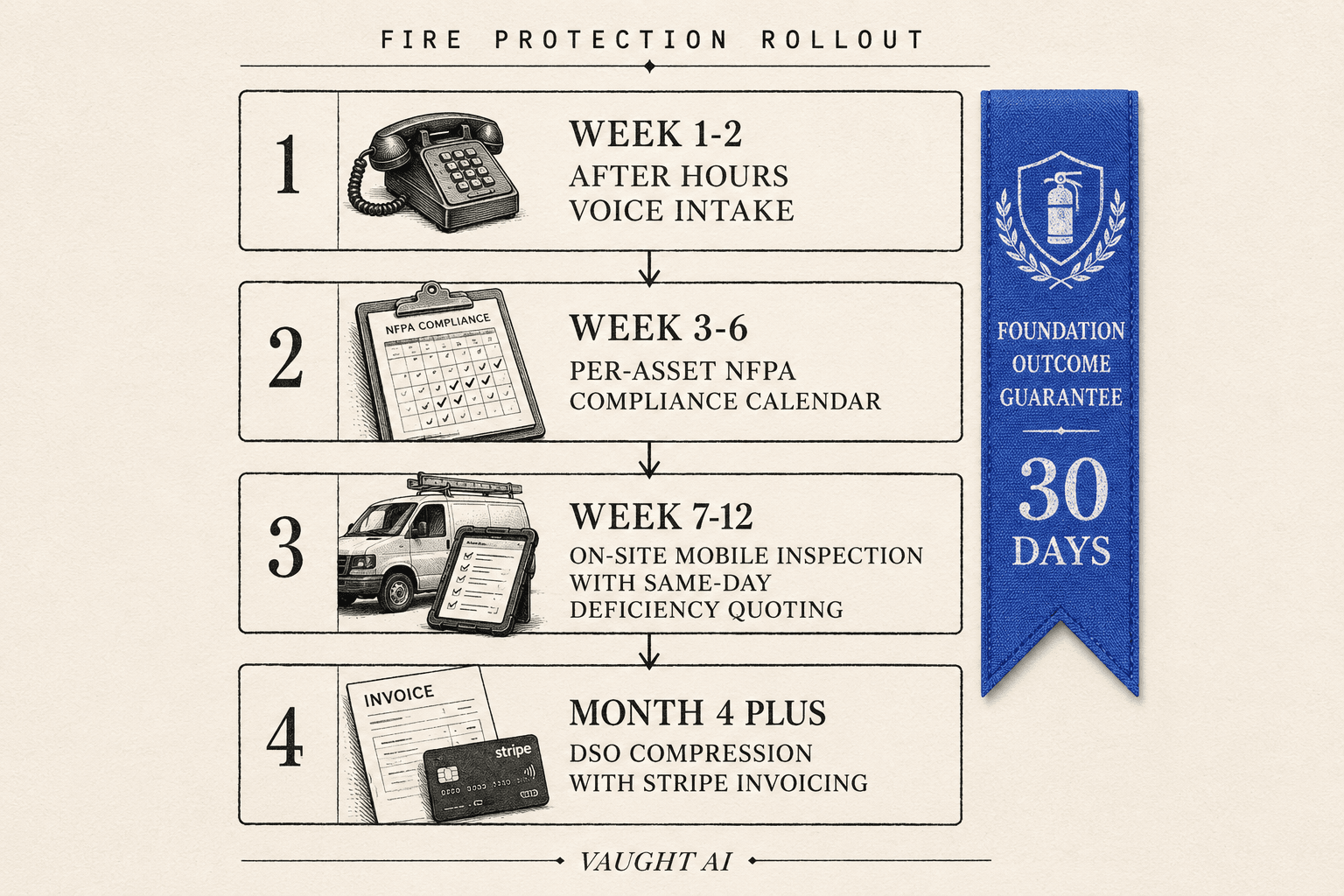
Week 1 to 2: Plug the after-hours intake leak. Voice agent answers everything inbound after 5 PM, on weekends, and during business-hour overflow when the office line is busy. Two-week pilot. Watch the booking rate and the trouble-signal dispatch time delta. This is the biggest dollar leak in raw lost-contract terms and the cleanest competitive win.
Week 3 to 6: Deploy the per-asset NFPA compliance calendar. Migrate your active customer base into per-asset tracking with code-section frequencies, 90 / 60 / 30 day escalation alerts, and AHJ-format reporting. This is where missed inspections stop and AHJ pulls become a 2-minute operation.
Week 7 to 12: Stand up the on-site mobile inspection workflow with same-day deficiency quoting. Techs run inspections on the iPad, deficiencies auto-populate quotes from your price list, property managers get the quote within the hour. This is where the second-revenue-line jump happens.
Month 4 onward: Tie it all together with the on-site invoicing and DSO compression layer. Stripe payment, auto-reminder cadence, working capital freed.
We package this as a Recovery Blueprint engagement. Foundation Outcome Guarantee: your first AI workflow is live in 30 days, or we do not bill the retainer. Built around your actual NFPA asset mix, your actual AHJ jurisdictions, your actual deficiency price list. Not generic.
A note on AHJ relationships, arc-flash, and where the lines actually are
Two things AI does NOT touch in fire protection, and two things it absolutely does.
Does not touch: the AHJ relationship and the on-site judgment call. When the fire marshal walks the building with you, that is a human conversation about risk tolerance, code interpretation, and historical precedent. AI can pull every prior report from that AHJ in 2 minutes for the meeting. It cannot replace the conversation itself. Same for the on-site call when a tech has to decide whether a sprinkler head with light surface corrosion gets flagged as a 90-day deficiency or a 30-day priority. That is sensory judgment plus liability calibration plus customer relationship. Human work.
Does touch: the documentation around the relationship and the call. AI generates the deficiency report in the AHJ's required format. AI surfaces the prior precedent ("this AHJ has accepted Category C on deflector corrosion the last 4 times"). AI calibrates the price list against your firm's historical data so quotes go out at the rate that actually wins the work. That is the part where the human gets the upside instead of doing the documentation grunt work.
For arc-flash and energized-cabinet work, the calculus is structurally similar. AI does not stand in front of an energized 480V switchboard wearing Category 4 PPE. It does generate the IEEE 1584 incident-energy labels from one-line diagrams, flag dispatch errors when an uncertified tech gets assigned to an energized cabinet, and track NFPA 70E refresh on every tech's file so nobody works hot on an expired cert. We build that layer for shops that handle electrical-side fire protection work. The actual energized work is human, properly equipped, properly certified.
Frequently asked questions
How is this different from Inspect Point or BuildingReports?+
Inspect Point and BuildingReports run your inspection scheduling and your AHJ-format reports. They are good at it. They are not built to answer 6 AM panel-trouble calls on the second ring, generate deficiency quotes on-site in your firm's voice within the hour, or handle jurisdiction-specific code variants for niche verticals (industrial, healthcare, military). We build the workflow layers that feed Inspect Point inputs or replace Inspect Point entirely depending on shop size and platform fee math.
Do I have to replace ServiceTrade?+
No. The workflows we build sit on top of your existing FSM and write back to it. Voice intake creates the dispatch ticket in ServiceTrade. The compliance calendar reads NFPA frequencies from your asset records. The deficiency quoting workflow logs the quote to the customer's ServiceTrade account. Your team still works in the system they already know.
Is the voice agent NFPA-aware?+
It is trained on your firm's actual emergency response playbook. Trouble signal versus supervisory versus active alarm versus low-pressure alarm versus carbon monoxide alarm all get different dispatch protocols. The voice agent identifies the category from the caller's description, pulls the building's service history, matches the on-call tech to the system type, and creates the ticket. NFPA codes themselves are the dispatcher reference manual, not the voice agent's training set.
How much does this cost to build?+
For a 10-tech fire protection shop, the typical engagement is $18,000 to $40,000 in build cost spread over 8 to 14 weeks, plus a monthly retainer ($799 to $1,499) covering ongoing support, model upgrades, and workflow tuning. The full four-workflow rollout pays for itself in the first quarter on after-hours dispatch and same-day deficiency quoting alone. The compliance calendar and DSO compression gains compound from there.
Can the mobile inspection workflow handle offline sites?+
Yes. The Noble build runs as an offline-capable PWA on the tech's iPad. Inspections in basements, mechanical rooms, and rural sites without signal work normally. The data syncs to the cloud the moment the device reconnects. This is non-negotiable for fire protection work and we will not deploy a workflow that breaks at a site without WiFi.
What happens when the AHJ updates a code cycle mid-year?+
The compliance calendar reads jurisdiction-by-jurisdiction code adoption. When Norman adopts NFPA 25 (2023 edition) and OKC is still on 2020, every job in our system ties to the jurisdiction's current adopted edition. New code requirements flag automatically. We update the compliance ruleset within 30 days of any adoption change.
Will this work for a 2-truck shop?+
The math gets tighter under 5 trucks. After-hours voice still pays back fast (the leak is structural, not size-dependent). The compliance calendar pays back even for solo operators because one missed inspection covers the build cost. The on-site mobile inspection workflow has a floor of about 800 inspections a year before the build cost pencils. A 2-truck shop is usually a voice-intake-plus-compliance-calendar engagement for the first 12 months.
How does this compare to the AI rollout for adjacent trades like HVAC?+
The architecture is structurally similar. We covered the four bottlenecks for [HVAC contractors](/blog/industry/hvac/ai-for-hvac-contractors) and [personal injury law firms](/blog/industry/personal-injury-lawyers/ai-for-personal-injury-lawyers) in companion pillar posts. The differences are vertical-specific: HVAC leans heaviest on mobile quoting velocity, PI leans heaviest on after-hours intake and demand cycle compression, fire protection leans heaviest on the compliance calendar and the deficiency quoting close rate.
See the playbook in action
One real live client build anchors every workflow in this post.
Noble Fire & Safety runs the full stack. Voice intake on after-hours emergencies. Per-asset NFPA compliance calendar across 10, 25, 72, 80, and 96. Offline-capable mobile inspection PWA on the techs' iPads. On-site deficiency quoting from a custom NFPA price list. Stripe-on-site invoicing with a 3 / 7 / 14 day auto-reminder cadence. Zero missed inspections since the switch. 5+ hours per tech per week back on the schedule. 100 percent digital field workflows. AHJ pull (the "I need every report on this building" request) drops from a half-day scramble to 2 minutes.
For the full fire-protection gap map (six workflow agents, the ROI calculator, the Recovery Blueprint download), see the Fire Protection industry playbook.
Joey Vaught, Founder, Vaught AI. Built by a former high-voltage field tech who wired airfield infrastructure on Navy bases, not by an agency.
30 min. We walk through your shop, map the four bottlenecks against your asset mix and AHJ jurisdictions, name the dollar floor on each leak, and show you which workflow to plug first. Foundation Outcome Guarantee: your first automation is live in 30 days, or we do not bill the retainer.