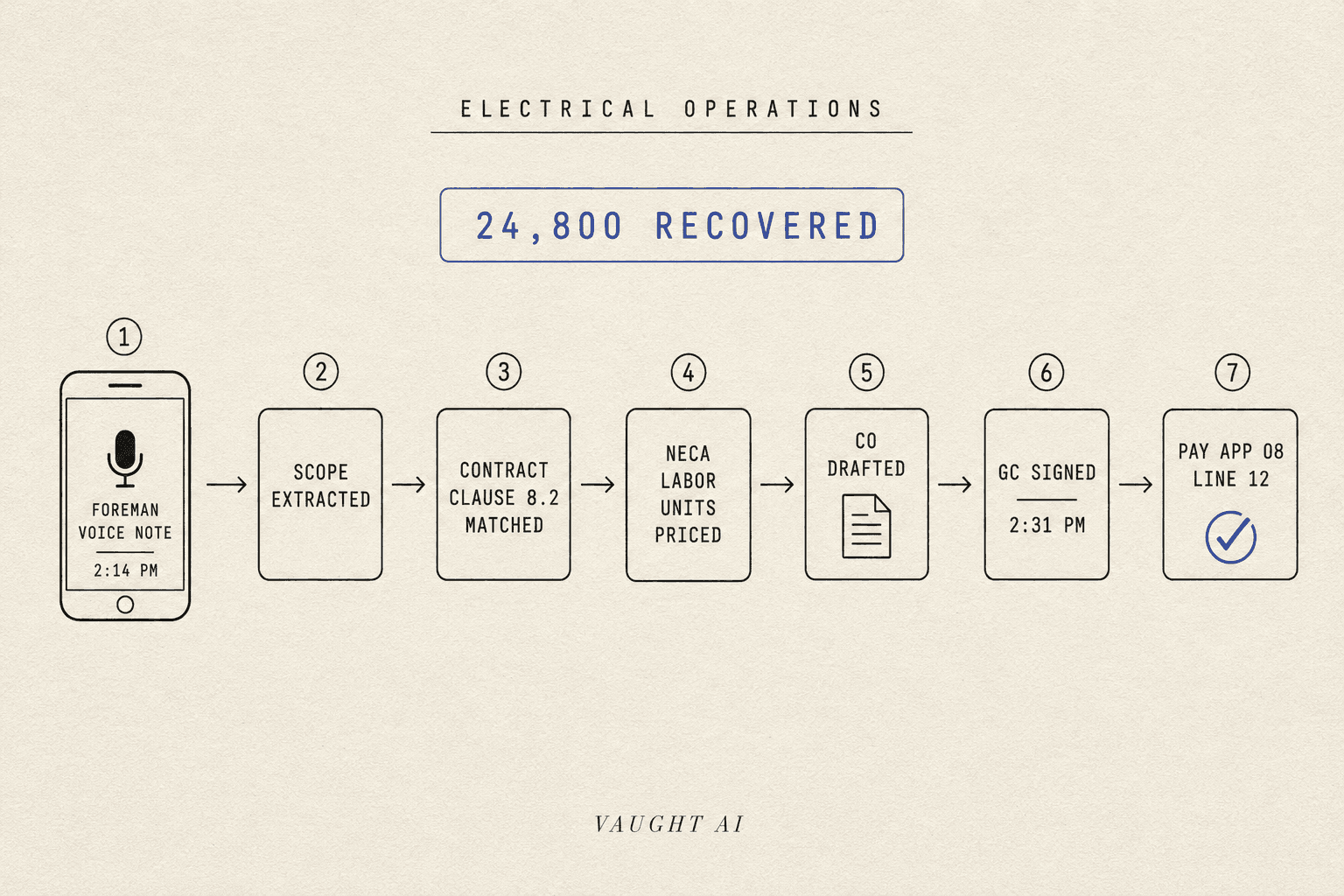
Last winter, an electrical contractor in Tulsa posted in a private Mike Holt forum thread: "Just finished my year-end review. We bid $4.2M of work this year. We did $3.1M. The other $1.1M was change orders we did and never billed. I have receipts and time cards and crew logs and a foreman who remembers every conversation. None of it got written up. None of it got signed. The GC paid us for the contract value and walked. That is my margin for the year, walking."
Forty-one replies. Every reply was a variation of the same story. Different city. Different GC. Same root cause: the change order lives in the foreman's head, the office never writes it up, the GC drags the sign-off three pay apps deep, and 32 percent of project revenue walks unbilled (Procore + Dodge 2025 study of 500 contractors).
That thread is the electrical industry in one screenshot. Electrical contractors carry 19 percent overhead against a 10 percent industry average (ELECTRI International). Switchgear lead times ran 44 weeks in Q2 2025 (Wood Mackenzie). Failed inspections cost 5 to 10 times the original task budget (ECodeAPI 2025). Oklahoma just doubled the CEU requirement to 12 hours every 3 years (HB 3215, effective January 2026). The margin pressure is brutal and the operational complexity is worse than any other trade.
This post is for the electrical contractor running a 3 to 30-truck shop doing $1M to $10M in OK or TX who keeps reading "AI for trades" headlines and wonders which slice of it actually moves money. Not the AI Overviews that summarize Accubid's marketing blog. Not the consultants quoting from McCormick's product deck. The four bottlenecks where AI quietly fixes the dollar leak while you are at a job-site doing the rooftop disconnect for a tenant improvement, the order to roll it out, and the math on the unbilled change order floor for a typical 10-truck commercial shop.
I pulled wire underground at NAVFAC. Helicopter pad approach lights, taxiway edge lighting, SEAL training pool electrical, hangar service entrances. I have stood in front of a 480V switchboard wearing Category 4 PPE. I know what your day actually looks like. AI does not crawl an attic. It does not megger-test a feeder. It does not stand in front of a tenant in a closet at 4 PM Friday and explain why their lighting circuit is going to take another two weeks because the gear is on a 30-week list. But it does stop the change orders from walking, the bid takeoffs from eating your estimator's week, the after-hours service intake from rolling to voicemail, and the master-of-record license from quietly lapsing while nobody is watching.
The 30-second answer
AI for electrical contractors, in practical terms for a 3 to 30-truck shop doing $1M to $10M in OK or TX, is not one product. It is four workflow agents that sit on top of your existing estimating stack (Accubid, ConEst, McCormick, Bluebeam) and fix the four specific bottlenecks where the dollar leaks live: change order capture (CO is a written amendment to the original contract scope; the Procore + Dodge 2025 study of 500 contractors found 32 percent of project revenue walks as unbilled COs), bid takeoff velocity (estimators burning 5 days on plan-counting against NECA labor units while the GC opens 12 bids the same week; NECA is the National Electrical Contractors Association, whose labor unit baselines are the industry standard for bid estimating), after-hours service call intake (commercial power-outs do not wait for office hours), and license-CEU-arc-flash tracking (NEC is the National Electrical Code on a 3-year revision cycle; Oklahoma HB 3215 doubled CEU to 12 hours every 3 years effective January 2026).
AI does not replace your foremen, your journeymen, your apprentices, your estimators, or your office manager. It replaces the answering service you are paying $1,200 a month to fail at your job, the office's typing-up of change orders the foreman already wrote on the rooftop, the estimator's 5-day burn-down on standard commercial bids, and the sticky-note system of CEU renewals that nobody is actually watching. The AHJ inspection, the energized cabinet, and the GC relationship: all still human.
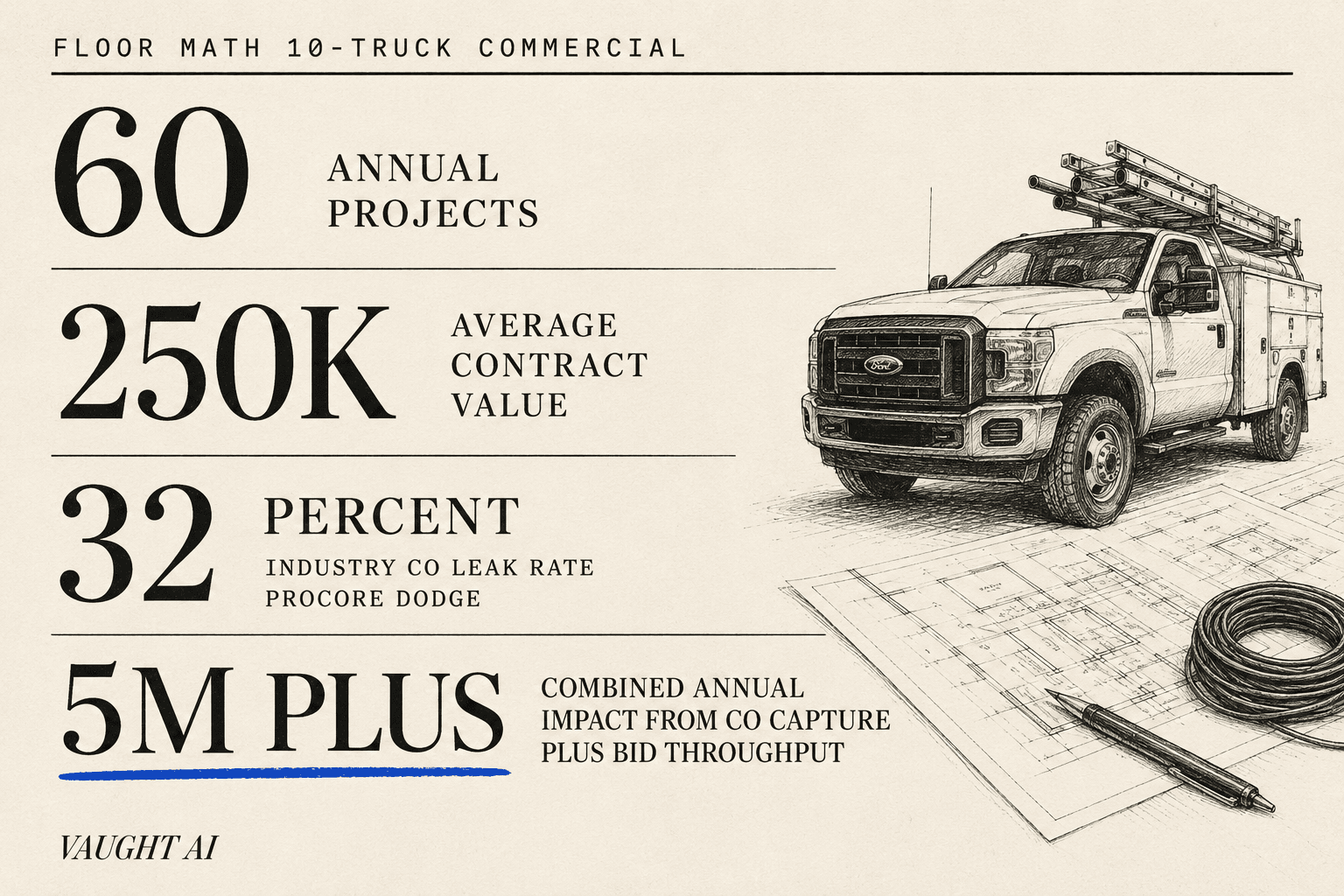
For a 10-truck commercial shop running 60 projects a year at $250K average contract value, the conservative dollar floor across the four workflows is +$5M a year in recovered margin and bid throughput (Vaught AI estimates against ELECTRI International overhead data showing electrical contractors carry 19 percent overhead against a 10 percent industry average, and Wood Mackenzie 2025 supply chain data showing 44-week switchgear and 128-week transformer lead times that surprise project schedules). The rest of this post breaks down each bottleneck, the math, and the order to roll it out.
The four bottlenecks AI actually fixes for electrical contractors
Most "AI for electricians" content lists 20 use cases and ranks them alphabetically. Half of them are document summarization that ChatGPT already does for free. Here are the four worth your money, ordered by dollar leak.
1. The change order that walks unbilled
This is the single biggest dollar leak in any commercial electrical shop. 32 percent of project revenue walks as unbilled change orders. The Procore + Dodge 2025 study ran the numbers on 500 contractors and found the typical project leaks $20,000 to $40,000 in unbilled scope. On an electrical contractor carrying 19 percent overhead, that hits net margin like a freight train.
The pattern is identical at every shop. The owner's rep says do it. The foreman does it. The CO never gets written up because the foreman is back on the roof for the next task. Or it gets written up two weeks later and the office cannot reconstruct the scope from a sticky note. Or the CO does get written and submitted and the GC's super drags the sign-off across three pay apps. By the time it should have hit the next pay app, the project is closed out and the office has moved on.
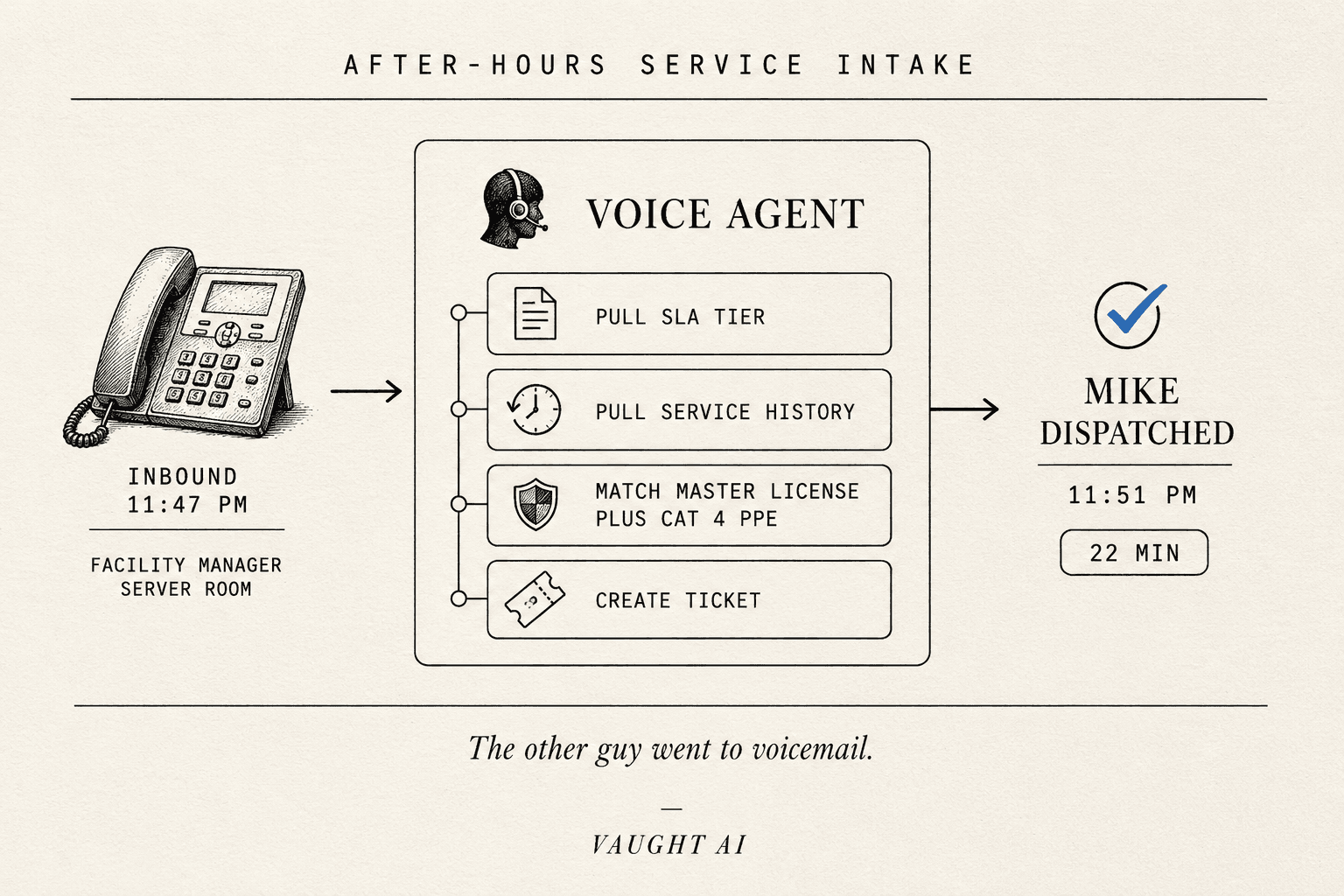
A change order capture workflow runs end-to-end in 17 minutes. The foreman texts a photo and a 20-second voice note from the field. The Brain transcribes the memo, extracts scope, pulls NECA labor units and parts pricing from your shop's actual data, and drafts the CO against the contract's markup clause (Section 8.2 T&M rate, 22 percent markup, 14-day terms). The GC's super gets a same-day e-sign request with the markup, the markup reasoning, and the contract clause that authorizes it. Approved COs land on the next pay app automatically.
We deployed the same shape for Meridian Shield, a metal fabrication shop where quote velocity was the bottleneck. Their per-quote time dropped from 60 minutes to under 5 with the same underlying architecture: structured field input + your own pricing data + auto-drafted document + e-sign. The electrical CO version is a one-month build on the same stack.
For a 10-truck commercial electrical shop running 60 active projects a year at an average $250K contract value, the math: 60 projects × $30,000 average unbilled CO leak × 70 percent recovery from the capture workflow = $1.26M a year in recovered margin. That is not a typo. That is what 32 percent of project revenue walking unbilled looks like when you actually do the multiplication on your own shop. The workflow pays for itself in week one.
2. Bid takeoff that takes 4 hours instead of 5 days
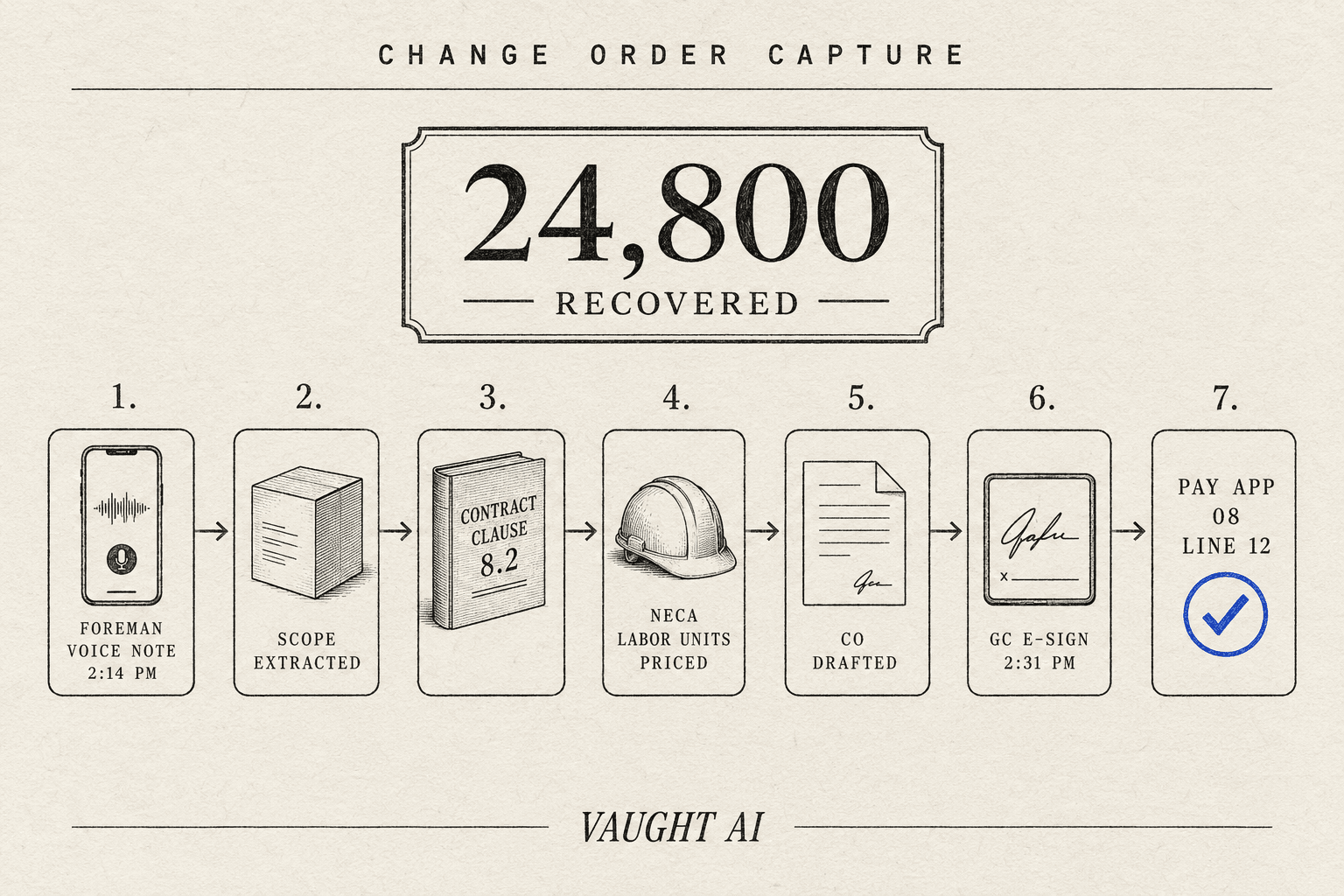
The estimator runs a PDF takeoff in Bluebeam. Hand-counts every receptacle, switch, light fixture, J-box, panel slot, conduit run. Copies into the assembly sheet. Prices it out in Accubid against templates that nobody updated since the last NEC cycle. The bid still misses the real labor unit count by 5 to 10 percent because the estimator is fast but human, and the GC opens twelve other bids the same week.
The first bid in sets the price. Yours has never been the first bid in.
AI bid takeoff is now reliable enough for production use on standard commercial work (tenant improvements, retail build-outs, office fit-outs, light industrial). Upload the GC's plan PDF. The AI runs the takeoff in under 15 minutes. It counts devices, sizes conductors, pulls panel schedules, composes assemblies, and applies your shop's actual NECA labor units (not the generic baseline, your shop's data). Estimator reviews, adjusts, ships the bid in hours instead of days.
The honest framing: AI bid takeoff is not magic on heavy industrial, on healthcare with infection-control gear, or on anything with significant low-voltage or specialty systems integration. It works on the 70 to 80 percent of your bid mix that is standard commercial. For that slice, the estimator goes from 5 days per bid to 4 hours. Bid throughput triples without hiring. Bid accuracy improves because the labor units pull from real data instead of memory.
For a 2-estimator shop bidding $35M of work a year at a 15 percent win rate, the math: tripling bid throughput on the standard-commercial slice (60 percent of pipeline) without losing accuracy increases win-rate-weighted contract value by $4.5M to $7M a year. Plus the estimator gets her week back. That is a different category of operator quality of life. Mike Holt's forum says it plain: failure to know the cost of doing business is the number one reason electrical contractors fail. AI bid takeoff fixes the part of the problem where the shop has the data and just cannot run it fast enough to be first in.
3. The after-hours service intake (the call your competition is missing)
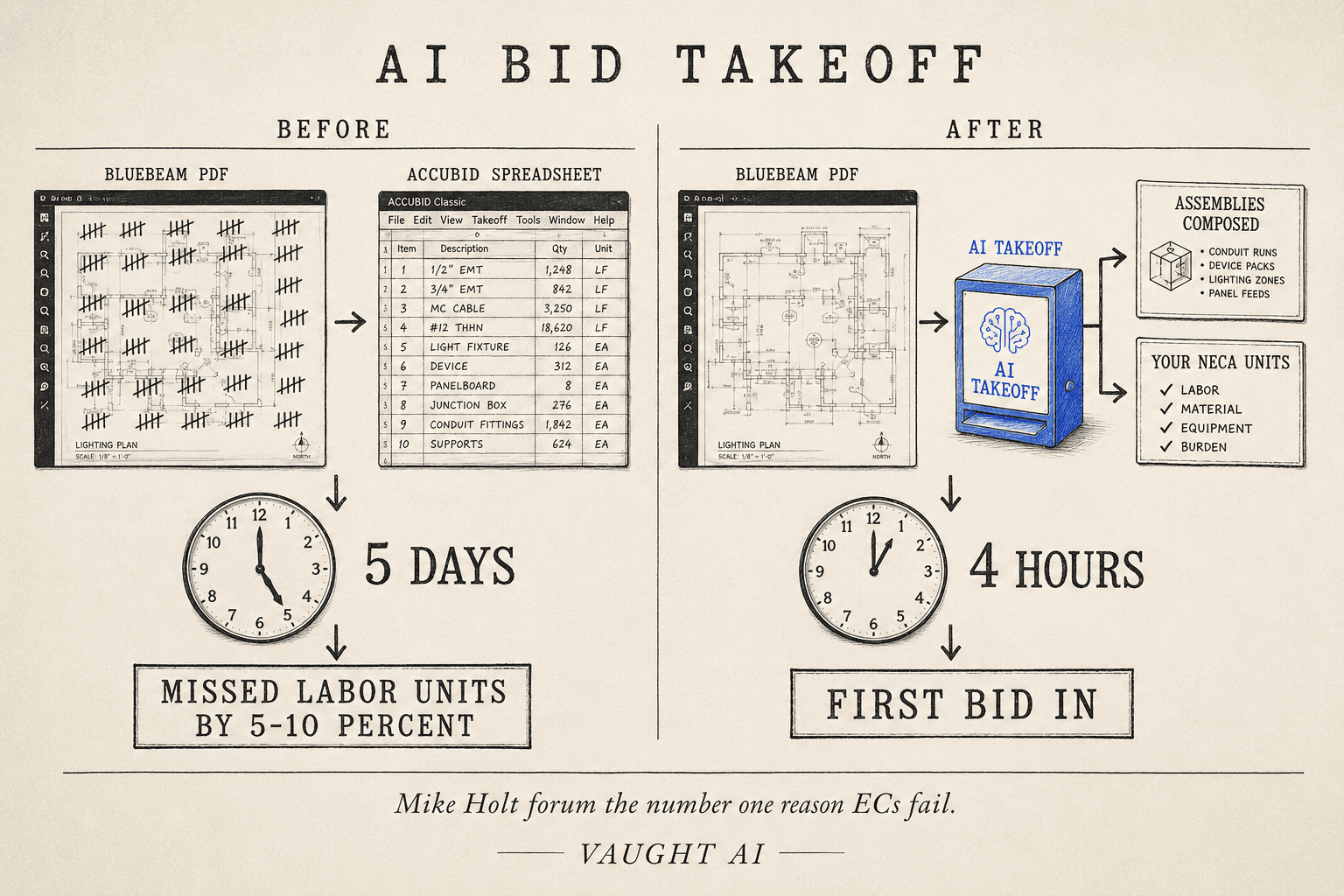
Commercial power-out calls do not come at 2 PM Tuesday. They come at 11:47 PM Saturday when a restaurant freezer drops a 200-amp feeder. They come at 6 AM Sunday when a server room HVAC compressor trips and an IT director is watching the rack temp climb. They come during halftime when the dental office's sterilizer trips a GFCI and the next morning's patient appointments are at risk.
Most electrical shops handle this the same way. The phone rolls to a $1,200-a-month answering service that takes a message. The on-call tech finds out about it 90 minutes later when somebody listens to voicemail. By that point the facility manager has already called two other shops. Whoever picks up first dispatches first. You finish your beer at 9 PM Sunday and find out Monday that you lost a service contract over a 90-minute lag.
A trained voice agent on the same architecture we deployed for Noble Fire & Safety answers on the second ring. It pulls the service contract status (SLA tier, response time guarantee), pulls the building's service history, matches an on-call tech with the right license (master of record for energized work, Cat 4 PPE certification for arc-flash exposure, OSHA 10 minimum), creates a dispatch ticket, gives the facility manager an ETA, and texts the tech with the building access details. All before the facility manager calls the second number on his list.
For a 10-truck electrical shop with a service-and-emergency book of business, the conservative math: 6 to 12 after-hours emergency calls a month, 35 to 50 percent of which become competitive shopping events when the call rolls to voicemail. At $3,500 to $7,500 average emergency-response invoice plus annual service-contract value of $8,000 to $15,000 per recovered client, the after-hours leak is $50,000 to $120,000 a year in directly billable work and another $40,000 to $100,000 in saved recurring service-agreement revenue from clients you would have lost.
4. License, CEU, and arc-flash tracking (the silent business killer)
Effective January 2026, Oklahoma's Construction Industries Board doubled the master and journeyman CEU requirement from 6 hours to 12 hours every 3 years (HB 3215). Texas TDLR mandates 4 hours per cycle including a minimum 1 hour of NEC review. NEC code adoption runs on a 3-year cycle. Your jurisdictions are on different cycles (Tulsa on 2020, OKC just adopted 2023, Norman still in review). Arc-flash incident-energy labels need refresh whenever the upstream impedance changes (NFPA 70E Article 130.5, IEEE 1584 calculation method). OSHA willful violation penalty for arc-flash exposure is now capped at $165,532 (2025 schedule).
Most electrical contractors track all of this in some combination of sticky notes, the owner's spouse's reminder system, a spreadsheet that breaks the moment somebody moves a row, and the panic two weeks before renewal when somebody realizes the master of record's license was supposed to renew last month. The master license is a business prerequisite, not a card in a wallet. The shop loses the license, the shop loses the ability to pull permits. The whole business stops.
A license and compliance tracker is structurally a calendar with rules. Master of record license expiration with 90 / 60 / 30 day alerts. Journeyman cards with the same. Apprentice ratios per state. NFPA 70E refresh by tech. OSHA 10 and 30 by tech. NEC CEUs by tech and by jurisdiction (12 in OK as of January 2026, 4 in TX per cycle). Arc-flash labels by job site with regeneration triggers when upstream impedance changes. Dispatch refuses to assign an energized cabinet to an uncertified tech.
For a 10-truck shop with 1 master, 4 journeymen, and 6 apprentices, the math on this layer is less about dollar recovery and more about avoided catastrophe. One missed CEU cycle that lapses the master of record costs the shop roughly $8,000 to $25,000 in permit fees, deferred work, and re-certification expedite costs. One arc-flash incident with an OSHA willful finding lands at $165,532 per violation plus the deeper costs of the lawsuit, the workers' comp exposure, and the AHJ relationship damage. The compliance tracker is the cheapest insurance you can buy.
Will AI replace your techs, journeymen, foremen, or estimators?
No. Electrical is more insulated from displacement than any other trade. The work is physical, the diagnostics are sensory (smell of burnt insulation, sound of a contactor chattering, feel of a too-warm panel cover), the AHJ relationship is relational, and the energized work has a liability profile that no AI vendor will touch. I pulled wire underground at NAVFAC for years. AI does not climb a 40-foot pole. It does not crawl an attic at 4 PM in August. It does not stand in front of an inspector and walk through a failed rough-in.
What AI does replace is the answering service you are paying $1,200 a month to fail at your job, the office's typing-up of the change order the foreman dictated on the rooftop, the estimator's 5-day takeoff burn-down on standard commercial, and the spreadsheet of CEU renewals that nobody is actually watching. That is the part of the work nobody enjoys and nobody is required to do as a human.
Your techs get to be techs. Your foreman gets to stay on the roof. Your estimator gets to spend her week on the heavy industrial bid that AI does not touch. Your office manager stops typing reports and starts running the parts of the business that need a human (GC relationships, AHJ liaison, problem clients, vendor management, the things actually worth her loaded hourly rate).
The hidden math on unbilled change orders (and bid throughput)
Most electrical owners feel the change-order pain. Few have done the math. Here is the floor.
Industry numbers. Procore + Dodge 2025 study: 32 percent of commercial electrical project revenue walks as unbilled change orders. Average leak per project: $20,000 to $40,000. ELECTRI International: electrical contractors carry 19 percent overhead against a 10 percent industry average. Northeastern Advisors 2026 EC Industry Report: labor is 40 to 60 percent of every job cost. Wood Mackenzie 2025: switchgear lead times running 44 weeks, transformers 128 weeks, pad-mount three-phase still getting worse because data centers got there first.
For a 10-truck commercial shop doing 60 projects a year at $250K average contract value, the floor math: 60 projects × $30,000 average unbilled CO × 32 percent industry leak = $1.8M a year in revenue at the FULL leak rate. Even a CO capture workflow that recovers 60 percent of the leak (conservative) puts $1.08M back on the books. The shop's annual labor cost is roughly $1.5M to $2M at the 10-truck size. The CO capture workflow alone is a labor-equivalent line item.
Layered underneath: the bid throughput gain on standard commercial work. 2 estimators bidding 35 weeks a year at 1.5 bids per estimator per week = 105 bids a year. AI takeoff triples throughput on the standard slice (60 percent of pipeline) = 168 standard bids plus 42 heavy bids per estimator pair = 210 total. At 15 percent win rate × $250K average contract = $7.9M in won work versus $3.9M baseline. The bid throughput gain is roughly $4M a year. Combined with the CO capture: $5M+ a year on a 10-truck shop.
These are conservative estimates pulled from the public industry studies. Your shop's actual numbers will vary based on the GC mix, the project mix, the bid throughput baseline, and the current CO capture discipline. The floor math is brutal even at the conservative end.
What about Accubid, ConEst, Bluebeam, McCormick, and the rest?
Honest answer: if you have one, keep it. Accubid runs your estimating database, your labor unit baselines, your pricing tier matrix. ConEst handles the takeoff layer. Bluebeam is the markup tool the estimator already lives in. McCormick is the small-shop alternative. They are all good at what they were built for.
What none of them do well: they do not capture change orders from a foreman's voice note in the field, they do not draft the CO against the contract's markup clause and fire the e-sign, they do not answer after-hours service calls with master-license-matched dispatch, they do not run the per-tech CEU calendar across multiple jurisdictions, they do not generate IEEE 1584 arc-flash labels from one-line diagrams.
The estimating platforms are upstream of the workflows that move money on the OTHER 80 percent of the day. They are great at the bid layer. They are not built for the change-order layer, the service-intake layer, or the compliance-tracking layer. Those gaps are where the dollar leaks actually live.
For shops under $5M, the cheapest move is a custom workflow layer that sits alongside Accubid (or replaces the cheap-template Accubid setup if it never got tuned properly) and fits your actual project mix, your actual GC clients, your actual NECA labor unit data. We do not replace Accubid. We add the four workflows Accubid was never built to run.
For shops over $10M with multi-state operations, the calculus shifts. The integrated AI features inside the bigger estimating-and-PM platforms (Procore Estimating AI, Foundation Software's AI module) start to make sense once integration cost stops outweighing platform cost. Below $10M, the platform tax dominates and the custom layer wins.
How to start: the order operations actually fix things
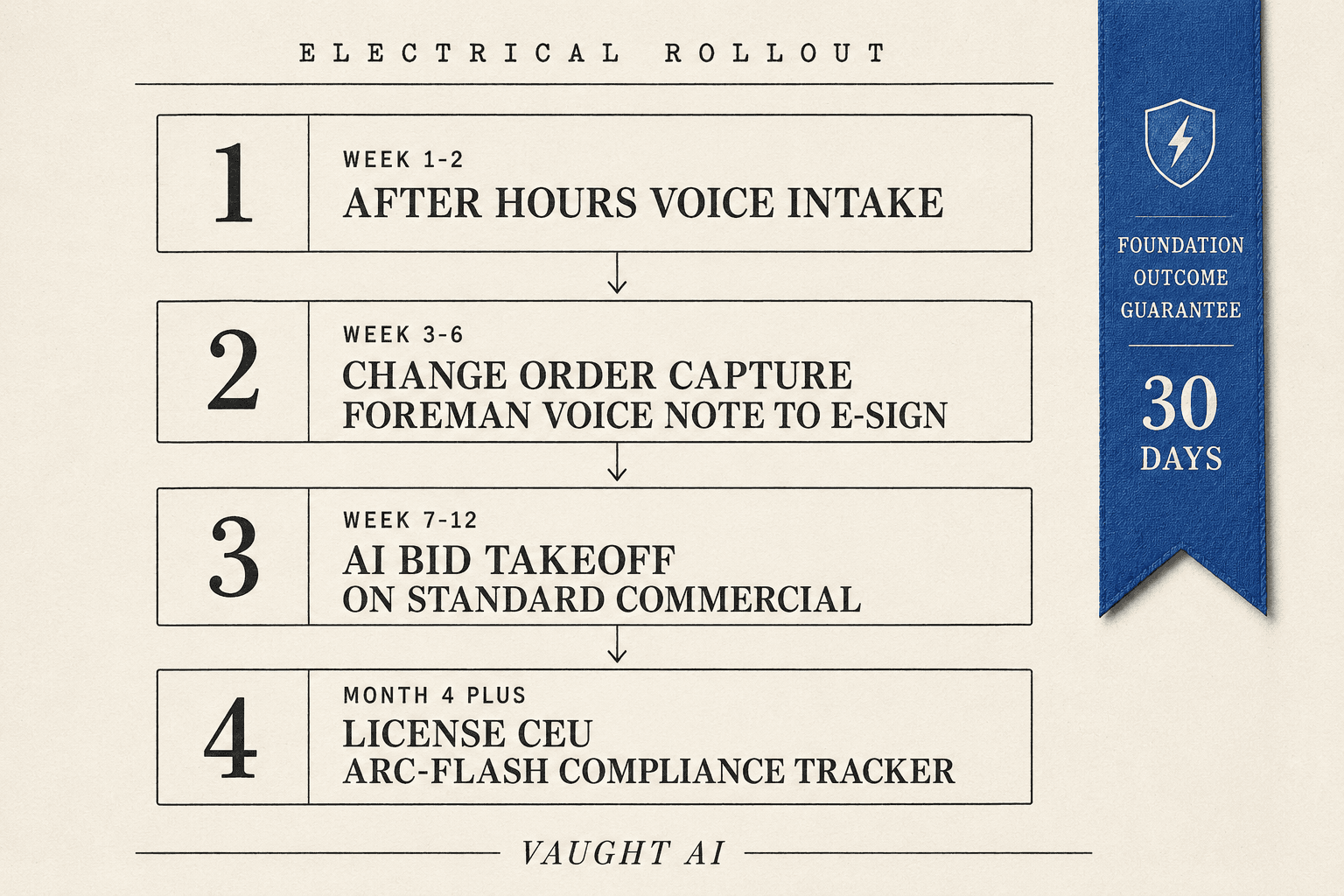
Do not try to turn on four AI workflows in the same month. The order that works for commercial electrical specifically:
Week 1 to 2: Plug the after-hours service intake leak. Voice agent answers everything inbound after 5 PM, on weekends, and during business-hour overflow. Two-week pilot. Watch the dispatch time delta on emergency calls. This is the cleanest competitive win and the fastest payback.
Week 3 to 6: Stand up the change order capture workflow. Foreman texts photo + voice note, AI drafts CO against contract markup clause, GC super gets same-day e-sign request, approved COs land on the next pay app. This is the biggest dollar leak in the shop and the workflow with the highest absolute impact.
Week 7 to 12: Deploy AI bid takeoff on standard commercial work. Estimator workflow shifts from 5-day burn-down to 4-hour review-and-ship. Bid throughput triples on the standard-commercial slice. Bid accuracy improves.
Month 4 onward: Tie it together with the license, CEU, and arc-flash tracker. 90 / 60 / 30 day alerts on every cert, NEC code-cycle matrix by jurisdiction, IEEE 1584 label generation from one-line diagrams. Dispatch refuses uncertified energized work.
We package this as a Recovery Blueprint engagement. Foundation Outcome Guarantee: your first AI workflow is live in 30 days, or we do not bill the retainer. Built around your actual GC mix, your actual NECA labor unit data, your actual jurisdictions. Not generic.
A note on the NEC, the AHJ, and the energized cabinet
Two things AI does NOT touch in commercial electrical work, and two things it absolutely does.
Does not touch: the AHJ inspection and the energized cabinet. When the inspector walks the rough-in with you, that is a human conversation about code interpretation, jurisdiction-specific precedent, and risk tolerance. AI can pull every prior failed rough on that AHJ in 2 minutes for the pre-inspect checklist. It cannot replace the inspector relationship. Same for the energized cabinet at 480V. AI does not stand in front of a switchboard wearing Cat 4 PPE. The energized work is human, properly equipped, properly certified. We will not deploy a workflow that pretends otherwise.
Does touch: the documentation around the AHJ relationship and the dispatch decision around the energized work. AI generates the pre-inspect checklist by jurisdiction and code section. AI surfaces the prior precedent ("this AHJ has flagged box fill on the last 3 jobs in this code section"). AI generates the IEEE 1584 incident-energy labels from one-line diagrams. AI refuses dispatch on an energized cabinet when the assigned tech's NFPA 70E refresh is expired. That is the part where the human gets the upside and the documentation grunt work goes away.
Frequently asked questions
How is this different from Accubid or ConEst?+
Accubid runs your estimating database and labor unit baselines. ConEst handles takeoff. They are good at the bid layer. They are not built to capture change orders from a foreman's voice note in the field, answer after-hours service calls with license-matched dispatch, or track NEC code cycles by jurisdiction. We build the workflow layers that surround the estimating platform, not the estimating platform itself.
Do I have to replace Bluebeam?+
No. The AI takeoff workflow exports clean device counts, conductor sizing, and assembly lists into a format that drops into your existing Bluebeam markup. Your estimator still works in Bluebeam. The 5-day-to-4-hour gain is on the takeoff itself, not on the markup-and-review step that Bluebeam handles.
Is the AI bid takeoff accurate on heavy industrial?+
Not yet. Heavy industrial, healthcare with infection-control gear, and bids with significant low-voltage or specialty systems integration still need a human estimator running the takeoff. AI bid takeoff is reliable for production use on standard commercial work (tenant improvements, retail build-outs, office fit-outs, light industrial), which is 60 to 80 percent of most commercial electrical pipelines.
How much does this cost to build?+
For a 10-truck commercial electrical shop, the typical engagement is $20,000 to $45,000 in build cost spread over 10 to 14 weeks, plus a monthly retainer ($899 to $1,499) covering ongoing support, model upgrades, and workflow tuning. The full four-workflow rollout pays for itself in the first quarter on change order capture alone. The bid throughput and after-hours intake gains compound from there.
Can the voice agent handle commercial service contracts with SLA tiers?+
Yes. The agent reads the caller's service-contract status, identifies the SLA tier and response-time guarantee, and dispatches based on the matrix you set. A 24-hour SLA contract gets a different routing than a 4-hour critical-response contract. The agent gives the facility manager an ETA on the call that respects the contract you actually sold.
What happens when the OK CIB or TX TDLR changes a CEU rule?+
The compliance tracker reads jurisdiction-by-jurisdiction rule sets. When OK doubled CEU to 12 hours in January 2026, every active master and journeyman in the system flagged for the new requirement on the next renewal cycle. We update the ruleset within 30 days of any adoption change. Tracker pulls from public AHJ databases plus the CIB and TDLR portals where they expose data.
Will this work for a 2-truck residential shop?+
The math gets tighter under 5 trucks and shifts heavily if you are residential service-only versus commercial new-construction. After-hours voice still pays back fast on commercial service contracts. The CO capture workflow has a floor of roughly $1M in commercial GC pipeline before the build cost pencils. A 2-truck residential service shop is usually a voice-intake-plus-compliance-tracker engagement for the first 12 months.
How does this compare to the AI rollout for adjacent trades?+
The architecture is structurally similar across the trades. We covered the four bottlenecks for [HVAC contractors](/blog/industry/hvac/ai-for-hvac-contractors), [fire protection companies](/blog/industry/fire-safety/ai-for-fire-protection-companies), and [personal injury law firms](/blog/industry/personal-injury-lawyers/ai-for-personal-injury-lawyers) in companion pillar posts. Electrical leans hardest on the change order capture layer (the 32 percent unbilled leak is unique to commercial construction) and on the license/CEU/arc-flash tracking layer (the regulatory complexity is unique to the trade).
See the playbook in action
Two real client builds anchor the workflows in this post. Different verticals, same architectural pattern.
Velocity workflow, Meridian Shield: the Trivan Roofing metal-fab arm. Quote time dropped from 60 minutes to under 5 minutes, daily quote capacity tripled, zero material miscalculations. The same shape ports directly to electrical change order capture (structured field input + your own pricing data + auto-drafted document + e-sign) and to AI bid takeoff (PDF in, assembly list out, your labor units).
Recurring service workflow, Noble Fire & Safety: zero missed inspections since the switch, 5+ hours saved per tech per week, mobile-first PWA that works offline in mechanical rooms. The voice intake architecture ports directly to electrical commercial service-call dispatch. The compliance calendar ports to license/CEU/arc-flash tracking with a different rule set.
For the full electrical-contractor gap map (six workflow agents, the ROI calculator, the Recovery Blueprint download), see the Electrical Contractors industry playbook.
Joey Vaught, Founder, Vaught AI. Built by a former NAVFAC airfield electrician who pulled wire underground on Navy bases, not by an agency.
30 min. We walk through your shop, map the four bottlenecks against your GC mix and project type, name the dollar floor on each leak, and show you which workflow to plug first. Foundation Outcome Guarantee: your first automation is live in 30 days, or we do not bill the retainer.