If your business runs on spreadsheets and the cracks are starting to show, you're not imagining it. Between 88% and 94% of business spreadsheets contain errors. The fix isn't a better spreadsheet, a no-code converter, or another off-the-shelf platform you'll outgrow in six months. For businesses doing $1M to $10M in revenue, the answer is usually a custom app built around how your operation actually works.
Spreadsheets break when your business grows past them. No-code converters and off-the-shelf tools get you partway there but create new ceilings. Custom-built apps cost $12K to $40K, pay for themselves in 3 to 6 months, and last for years. This post covers how to know when it's time, what your real options are, and what the switch actually costs. With real numbers from 3 businesses that made the move.

The 5 Signs Your Business Has Outgrown Spreadsheets
You probably already know something is wrong. These are the patterns we see over and over in businesses that are ready to move on.
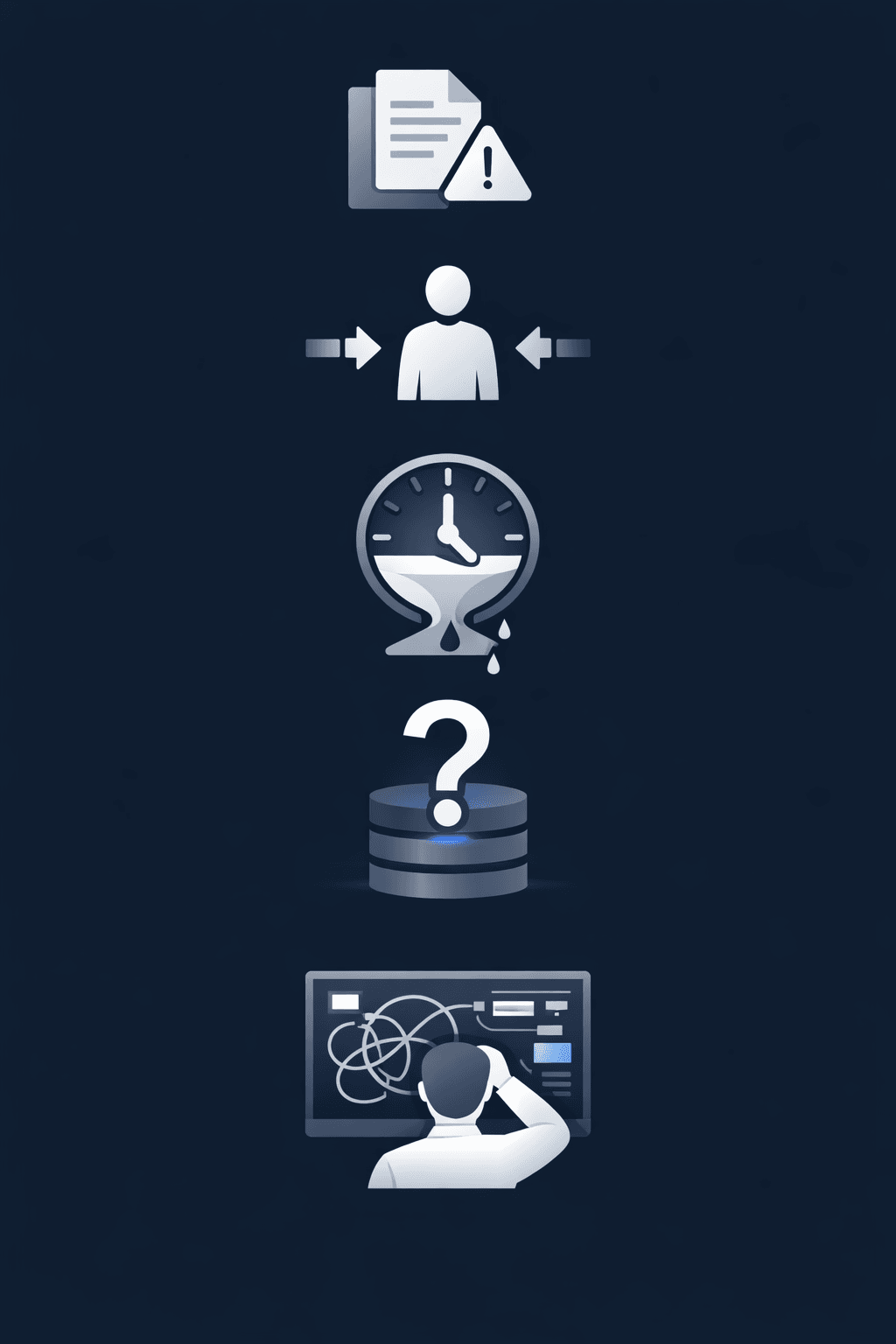
1. Multiple versions of the same file, and nobody knows which one is current. Someone emailed a copy last Tuesday. Someone else saved a version to the shared drive on Thursday. A third person has been working in their own copy all week. This is how $50,000 decisions get made on stale data.
2. One person is the "Excel expert" and nothing works without them. Every company running on spreadsheets has this person. They built the formulas, they understand the macros, and when they take a sick day, the whole operation slows down. That's not a tech stack. That's a single point of failure.
3. You're spending 10 to 20 hours a month on manual data entry and reconciliation. Research shows that small businesses lose 10 to 20 hours per month in low-value admin work tied to spreadsheet maintenance. That's a part-time employee's worth of hours spent copying, pasting, and double-checking numbers. I used to spend the last week of every month reconciling spreadsheets across my own manufacturing company. Not analyzing data. Not making decisions. Just making sure the numbers in six different files actually matched.
4. You can't answer basic business questions without digging. "How many jobs did we complete last month?" should take 5 seconds to answer. If it takes 15 minutes of filtering and cross-referencing, your spreadsheet has become a wall between you and your own data.
5. New employees take weeks to learn your system. If onboarding someone requires a guided tour of your spreadsheet, a cheat sheet of which tabs matter, and a warning about which cells not to touch, you've built a system that only makes sense to people who watched it evolve.
The Real Cost of Staying on Spreadsheets
The subscription is free. Everything else isn't.
The error rate alone should be enough to make you nervous. When nearly 9 out of 10 spreadsheets contain mistakes, you're not managing data. You're managing risk. And you probably don't know which numbers are wrong until something breaks.
Then there's the labor cost. Those 10 to 20 hours per month of admin work aren't just wasted time. They're hours your team could spend on work that actually grows the business. At $30 an hour, that's $3,600 to $7,200 per year in hidden labor costs. Per person.
And the biggest risk most businesses don't think about: what happens when the spreadsheet expert quits? If your operational knowledge lives inside one person's formulas and macros, you don't have a system. You have a liability.
Your Three Options (and Why Two of Them Fall Short)
When businesses decide to move off spreadsheets, they typically look at three paths. All three work. But they work for very different situations.
Option 1: No-Code Converters (Glide, AppSheet, Zoho Creator)
These platforms turn your existing spreadsheet into a basic app. You connect your Google Sheet or Excel file, and the tool generates forms, views, and dashboards on top of it.
Where they work: Simple use cases. A basic inventory tracker. A field data collection form. A personal CRM with fewer than 500 contacts.
Where they break: The moment you need real business logic. Role-based access so your sales team can't see your cost margins. Multi-step workflows where one action triggers the next. Complex calculations that depend on data from three different sources. You hit the ceiling fast, and now you're stuck in a tool that's too simple for what you need but too embedded to easily leave.
Option 2: Off-the-Shelf Software (Monday, Airtable, HubSpot, etc.)
Pre-built platforms designed for specific use cases. Polished interfaces, integrations, support teams.
Where they work: Standard business processes that match what the tool was designed for. If your sales process looks like every other sales process, HubSpot will serve you fine.
Where they break: You bend your process to fit the tool. Not the other way around. Monthly fees stack up across 3 to 5 platforms. Your data lives in someone else's system. And the feature you actually need is always in the next pricing tier up.
Option 3: A Custom App Built for Your Business
Production software designed around how your operation actually works. Your process drives the software. Not the other way around.
Where it works: Businesses with operational complexity that no existing tool handles well. Niche industries. Unique workflows. Companies that tried off-the-shelf and got burned.
The tradeoff: Higher upfront investment. Takes 6 to 10 weeks to build. But you own the code, you own the data, and it scales with you instead of against you.
No-code tools are great for prototyping. But I've never seen one survive contact with a real manufacturing floor or a field service operation with compliance requirements. The businesses I work with don't need a prettier spreadsheet. They need software that enforces their actual business rules, controls who sees what, and handles the edge cases that no off-the-shelf tool even knows exist.
How the Three Options Compare
Upfront cost: No-code runs $0 to $500. Off-the-shelf runs $0 to $2,000. Custom apps start at $12,000 and go to $40,000+.
Monthly cost: No-code is $25 to $100. Off-the-shelf is $50 to $500+. Custom apps run $499 to $1,499 on a retainer.
Time to deploy: No-code takes days. Off-the-shelf takes days to weeks. Custom apps take 6 to 10 weeks.
The real difference is fit. No-code partially fits your process. Off-the-shelf rarely fits. A custom app fits exactly. You own the code with a custom build. You don't with the other two. And only custom apps scale fully with your growth.
What Replacing Spreadsheets Actually Looks Like
Theory is fine. Here's what it looks like when real businesses make the switch.
Manufacturing: From 6 Spreadsheets to One Platform
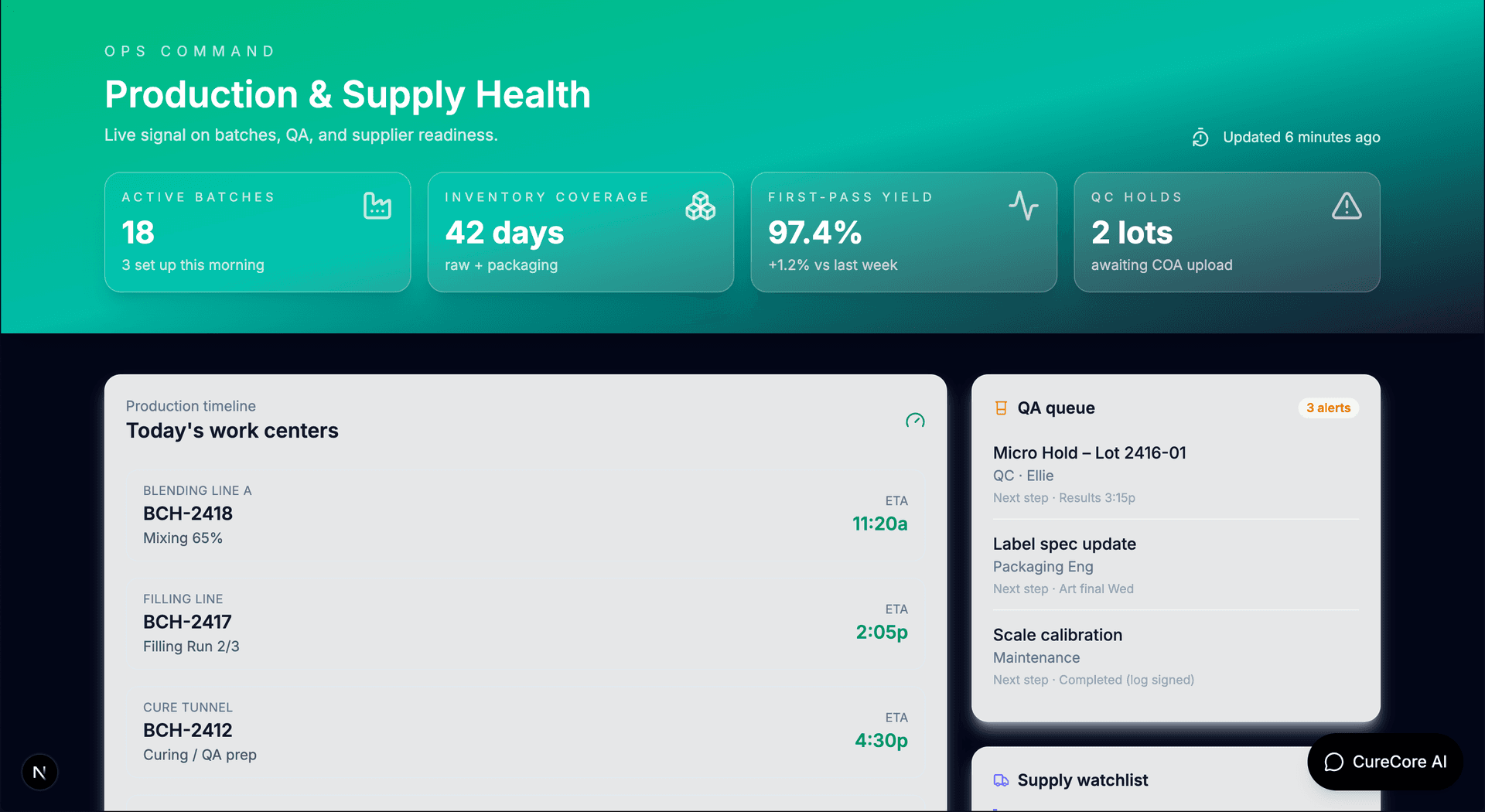
Cure Rituals is an organic skincare and CBD manufacturing company. Before CureCore, the operation ran on 6 separate spreadsheets managing the full product lifecycle, from raw ingredient receiving through formulation, production, packaging, quality control, and fulfillment. The last week of every month was spent reconciling numbers across files. One wrong formula could throw off an entire production batch.
CureCore replaced all 6 spreadsheets with a single platform. 20+ modules covering formulations, batch planning, manufacturing, packaging, quality control, inventory, CRM, and invoicing. 6 user roles across 3 departments with role-based access, so the operations team, sales team, and finance team each see exactly what they need and nothing else. Sequential workflow means each team acts on work in their queue and hands it off to the next.
I built CureCore for my own company because nothing on the market fit what we actually needed. The off-the-shelf tools either couldn't handle our compliance requirements for organic certifications and cannabinoid regulations, or they wanted us to change how we operate to fit their system. Now I just open the dashboard instead of spending a week reconciling spreadsheets.
The results: 45+ hours saved per week. Product launches 3x faster. ROI within 90 days.
Metal Fabrication: Quoting in Under 5 Minutes
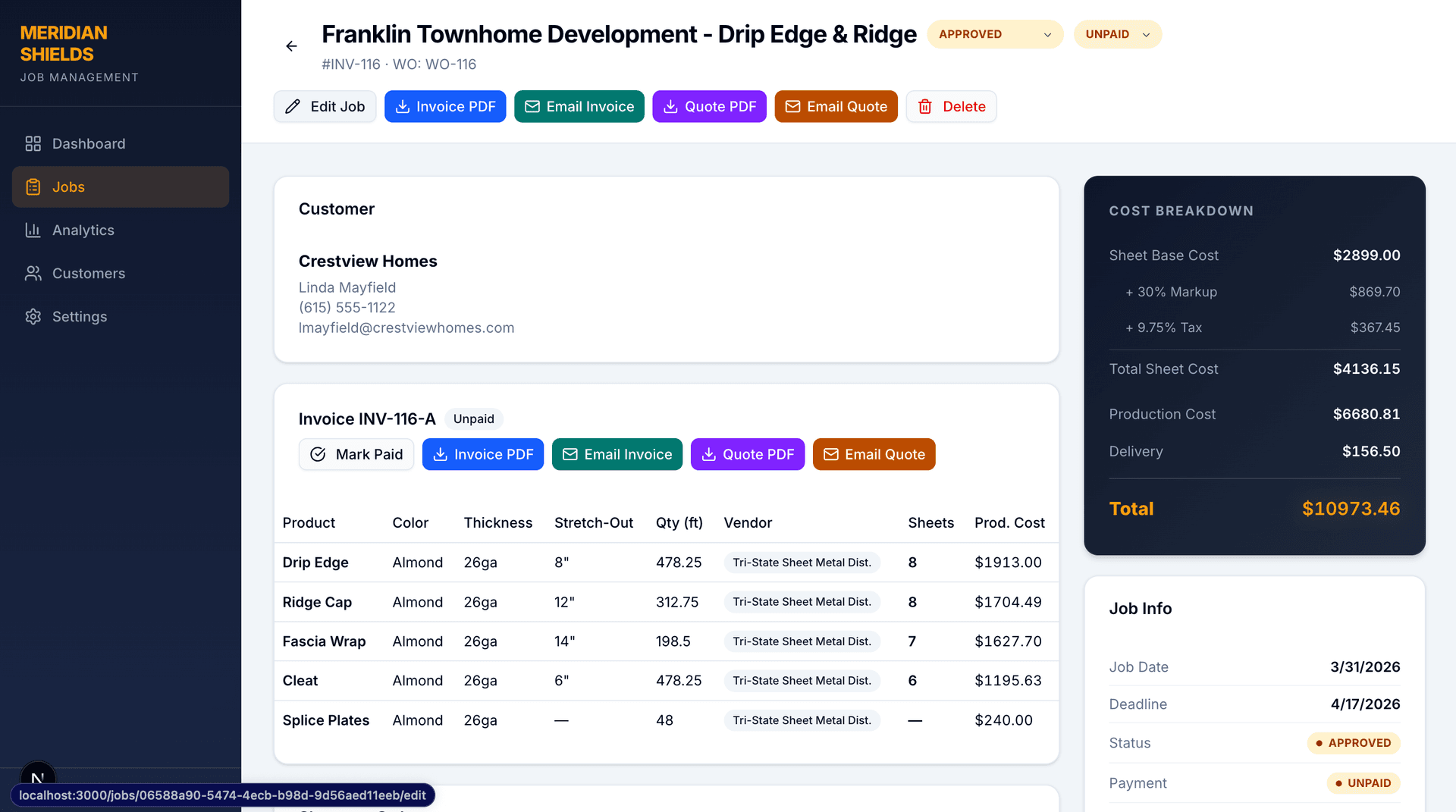
Meridian Shield is a commercial roofing edge metal fabrication company under Trivan Roofing. They bend and produce gutters, downspouts, flashing, fascia, coping cap, and other custom edge metal for commercial projects. Quoting a job meant manually calculating sheet metal requirements from stretch-out dimensions, looking up supplier costs per sheet, applying per-customer markup and tax rates, and typing it all into a spreadsheet. Each quote took 30 to 60 minutes.
The custom platform automates the entire calculation. A 4-step quoting wizard walks through customer selection, production items with auto-calculated sheet requirements, job details, and a full cost breakdown with markup and tax. The system handles the two-bucket pricing model automatically: material costs with markup and tax in one bucket, production costs separate. Per-customer pricing overrides, multi-supplier support, and auto-generated invoice numbers are all built in.
The results: Quoting dropped from 30 to 60 minutes to under 5. Daily output tripled. Zero material miscalculations. As the client put it: "The system paid for itself in the first month."
Field Services: Zero Missed Inspections
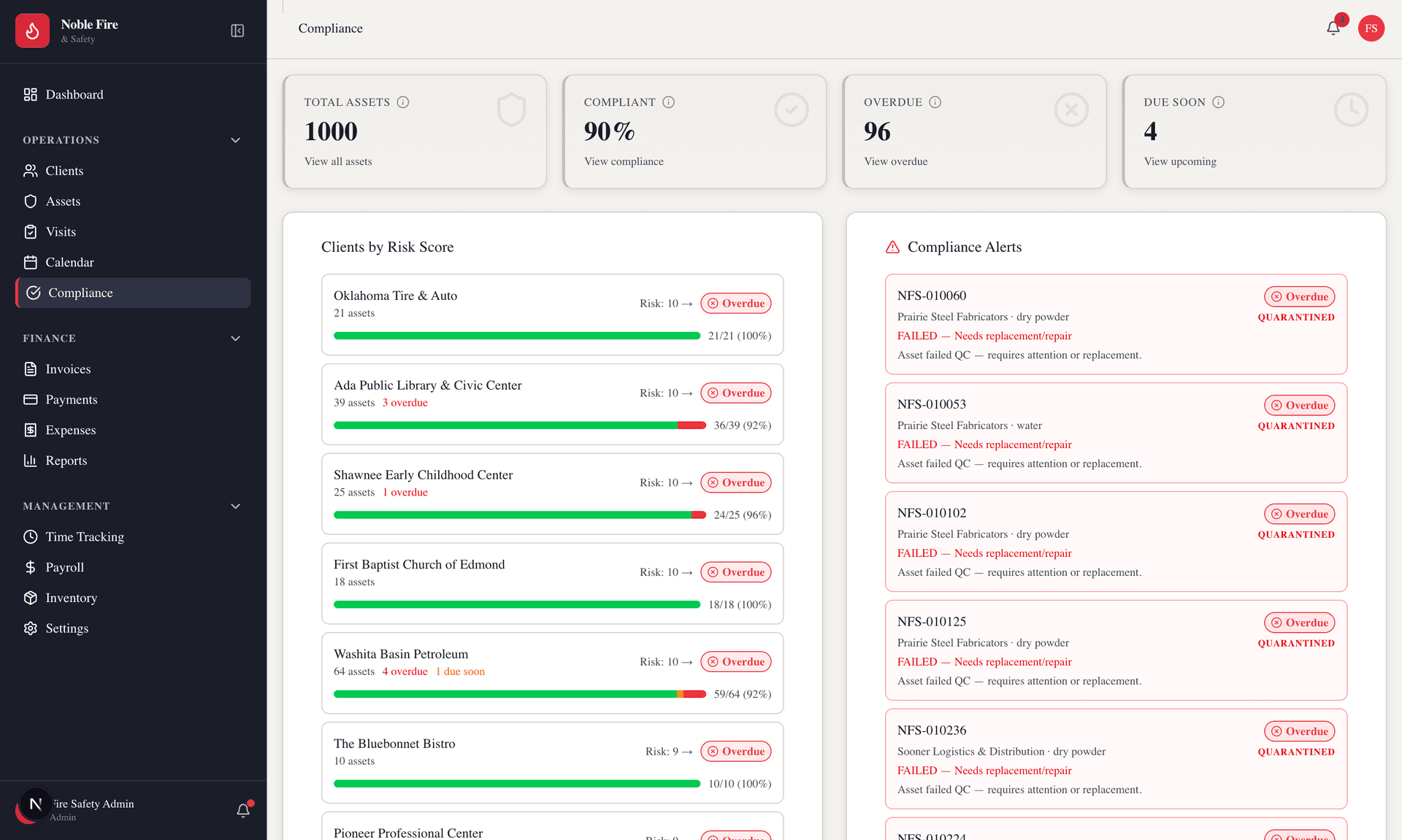
Noble Fire and Safety is a fire protection and inspection company. They service fire extinguishers, emergency lighting, and other life-safety equipment for commercial clients. Tracking NFPA compliance deadlines, scheduling technician visits, managing client assets, and handling invoicing were all separate processes running on spreadsheets and paper forms. In fire safety, a missed inspection isn't just an inconvenience. It's a compliance violation, a liability risk, and potentially a threat to people's safety.
The custom platform unified everything into one system. A compliance dashboard with real-time risk scoring across the entire client base catches overdue and due-soon inspections before they become problems. Technicians run a mobile-first workflow on their phones: inspect each asset, capture photos, collect digital signatures, generate invoice line items, and email the invoice to the client, all on-site, all working offline through the PWA. Clients log into their own portal to view assets, pay invoices through Stripe, and submit service requests.
The results: Zero missed inspections since the switch. 100% digital workflows, no more paper forms. 5+ hours saved per week on admin. "Our compliance risk went from constant worry to completely handled."
How Much Does It Cost?
Real pricing. Not the $15,000 to $500,000 ranges you'll find in generic articles.
Simple apps (5-8 screens, single role, basic dashboard) start at $12,000 with a $499/mo retainer. Timeline: 6-8 weeks. Mid-range apps (10-20 screens, 2-3 roles, integrations) start at $20,000 with a $799/mo retainer. Timeline: 8-10 weeks. Complex platforms (20-40+ screens, full role-based access, real-time data, audit trails) run $30,000 to $40,000+ with a $1,499/mo retainer. Timeline: 10-14 weeks.
For context: agencies typically charge $60,000 to $120,000 for the same scope of work.
And consider the alternative cost. CureCore saves 45+ hours per week. That's roughly $117,000 per year in recovered productivity. A $35,000 build pays for itself in about 4 months. Even at the Starter tier, if a $12,000 app saves your team 10 hours per week, you're looking at a payback period under 6 months.
Every engagement starts with a free AI Operations Audit. Fixed-price proposals after that. No hourly billing. No surprise invoices. You sign off on exactly what gets built before the build begins, and a monthly retainer after launch means we don't disappear after go-live.
How to Know If You're Ready
Not every business needs a custom app. Spreadsheets are fine for plenty of companies. Here's a quick check.
Are you doing $1M+ in revenue? Do 3 or more people touch the same data regularly? Are you losing more than 5 hours a week to manual data work? Has a spreadsheet error ever cost you real money or a customer? Are you hiring and need new people productive faster than your current system allows?
If you said yes to 3 or more of those, you've probably outgrown spreadsheets. The question isn't whether to move. It's what to move to.
FAQ
How do I know when my business has outgrown spreadsheets?+
When multiple people need to edit the same data, when you can't trust your own numbers, and when new hires take weeks to learn the system. If the spreadsheet has become the job instead of a tool for the job, it's time.
Can I convert my spreadsheet into an app without coding?+
Yes. Tools like Glide, AppSheet, and Zoho Creator do this. They work well for simple use cases. But they hit a ceiling quickly with complex business logic, role-based access, and multi-step workflows. For anything beyond basic forms and trackers, you'll outgrow them.
How long does it take to build a custom business app?+
6 to 10 weeks for most small businesses. Simple apps land on the shorter end. Complex platforms with multiple roles, integrations, and real-time data take closer to 10 to 14 weeks.
Is custom software worth it for a small business?+
If you're over $1M in revenue and losing measurable time to manual processes, yes. The math usually works out to a 3 to 6 month payback period. Below $1M, off-the-shelf tools are typically a better fit.
What happens to my existing spreadsheet data?+
It migrates into the new system. Your historical data doesn't disappear. The app is built on top of a real database, so your data is structured, searchable, and accessible to the right people with the right permissions.
What if my needs change after the app is built?+
That's what the monthly retainer covers. The app evolves with your business. New features, new integrations, adjustments to workflows. You're not locked into what was built on day one.
What to Do Next
If your business is running on spreadsheets and you're feeling the friction, start with a free AI Operations Audit. It's a 15-minute call where we map exactly where your spreadsheets are costing you time and money, and show you what a custom solution would look like. No pitch. Just a clear picture of what's possible.
I built CureCore because nothing on the market fit what my manufacturing company actually needed. Spreadsheets were holding the whole operation together, and they were the thing most likely to let it fall apart. If you're in the same spot, running a real business on tools that weren't built for it, let's talk.
30-minute call on Cal.com. We map your biggest time drain. No pitch.